Ally or Accomplice – by Nũr Johnson

This poem was composed by Nūr Johnson, a senior in the Justice Studies at Northeastern Illinois University.
Nūr, who is a CAPA intern, presented the poem at a program on “art as resistance” at the university, April 2, 2026.

The light within they try to take,
Beat me down to no awake.
(They) Kick and spit and call me names.
(They) Change the rules in the middle of the games.
You should be glad to even be here, you’re lucky.
They see more worth in a puppy than me   
But still I thrive and shine my light
‘Till they try to take it, with a fight.
I’m right, you’re wrong,
I’m big, I’m strong,
You’re nothing, you’re weak.
I want to hurt you, hear you shriek.
I want to be the one to take your shine
Keep it to myself, make it all mine.
I can never have enough; I need it all, call my bluff

So I called the bluff.
I am not afraid
To keep shining my light. I slowly prayed
God bless me through, please be my aid.
I won’t fight fire with fire.
I’ll use my light to outshine the darkness.
My light is mine to share with others; it can’t be harnessed.
I share it with my brothers and sisters and friends and teachers
But will they watch from the bleachers? When someone tries to take my light? Or will they stand up stand up and fight?
I need your help,
Will you help me?
Or will you stand and watch,
Stand and watch, watch me bleed,
Stand and watch
While I’m in an ocean lost at sea,
Stand and watch
While I lose my light to their greed?
Are you watching, or did you fight for me?

by

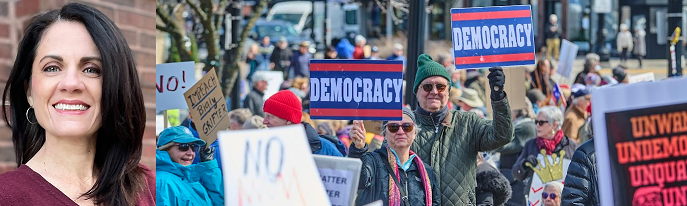
Democracy Needs All of Us – Erin Bosack

Erin Bosack is acting CAPA Co-President and delivered this speech at the Wilmette, IL No Kings Day Rally on 3/28/26.

Good morning. I’d like to ask you to do something. Take a moment to acknowledge yourself or someone else in the crowd for doing whatever it took to get here today. Anything you’ve done to work for peace and justice and democracy – big actions or small — it makes a difference. 

Is anyone here for their first protest ever?

And raise your hand if you’ve been doing this for a long damn time?

Okay, now make some noise if you are ready to create a world that works for everyone.

Most of us in this country want all the things that make life work — affordable healthcare and housing, good schools, wages that allow us to thrive, quality food and enough to eat, safe neighborhoods, infrastructure to combat climate change and an end to war. 

And yet our elected leaders fail miserably at representing these interests. Far too many politicians work for power, not for people. They commit our resources to forever wars. They inflict trauma. They take life. 

How do we change this?

Yes, by all means, we should go to the polls in November. We should work to get the most progressive candidates elected. But once they’re in office, we can’t go back to business as usual. It would be nice if we could trust our representatives to do the job of representing us and keeping the promises that compelled us to vote for them. But much too often, we can’t.

Even those who go into office with the best intentions find out quickly that the system is working against them, as well. Too often they are forced to compromise their values, to sell out, to give in. And before you know it, they’re voting to fund another genocide or passing a law that hurts their constituents while lining the pockets of oligarchs. We must say no more!

How do we transform a system that allows this to happen? 

We keep participating in our democracy even after an election. We hold elected officials accountable. We tell them over and over what we expect, we thank them when they do the right thing, and if they don’t…we own our power. 

If our government doesn’t work for us, we the people can withdraw our consent, stop cooperating, remind those who have gotten too comfortable with power and privilege that the people make this system run. Our labor and our consumer dollars keep it going. And we can withdraw them both. 

We say no to a government that refuses to acknowledge the harm it has done to black and brown people throughout history and continues to do to this day. A government that treats human beings as expendable in service of an economy that demands constant growth. A government that allocates more than half its discretionary budget to the military. One that spends more on defense than the next nine countries combined. 

We say no to politicians, whether Republican or Democrat, who wreak havoc around the world, kidnapping leaders, starving civilians, destroying infrastructure, ruining lives, all under the guise of spreading democracy and human rights, all while people at home suffer and as the militarism we enact abroad creeps its way further into our own society. 

How do we transform a system that refuses to affirm life? We organize and build community. We show our leaders that if they won’t take care of us, we will take care of each other. We will not disappear behind closed doors in fear. We will not turn on our neighbors.

The wealthiest 1% would love nothing more than for the rest of us to point fingers, place blame, and fight to the death if needed if it means they won’t be held accountable. Instead we have to come together building mutual aid networks, having difficult conversations when we don’t see eye to eye, showing up as one diverse people, and recognizing that what we have in common binds us much more than our differences separate us. 

Donald Trump is not an aberration. He is a symptom of a much larger problem. If we don’t do the hard work of calling out hypocrisy, challenging the accumulation of wealth, thinking critically, and restoring checks and balances, then another Trump will emerge to seize more power and sow more discord. 

It would be easy to despair in these conditions or to throw up our hands and say the problem is too big. That we’re not enough. But it’s not true. Alone we are not enough, but together we can be. Seek out stories of positive change that inspire you. Learn the history of movements that have succeeded, largely through the efforts of black and brown people, by enacting boycotts and legal challenges, mobilizing voters and lobbying legislators. 

And then look around. Whatever injustice you see, whatever upsets you most or lights a fire in your belly, there is a group somewhere working on it. Join them. Go to a meeting and take a friend. Ask questions. Learn about the issue and find out how you can help. Do your part. Democracy needs all of us, and showing up today is just the beginning.

Stop Going Backwards: Reviving Efforts to Control and Abolish Nuclear and Spaced-Based Arms Before It Is Simply Too Late – Jack Lawlor

Jack Lawlor is a member of the CAPA Foreign Policy Working Group and leader of the Buddhist Peace Fellowship’s Chicago Chapter.

This essay is an effort to enhance understanding among ordinary Americans about the perils of nuclear weapons and a new nuclear arms race that will include space-based weaponry.

I have participated in organizing annual commemorations of the tragedies of Hiroshima and Nagasaki in the Chicago area for many years.   There is now, after years of effort, growing interest in these subjects.  For good reason.

Let me begin by describing what I find most troubling at this time. Unfortunately, the list is a bit lengthy:

1. THE FAILURE OF THE U.S. AND RUSSIA TO EXTEND THE NEW START TREATY BEFORE IT EXPIRES IN FEBRUARY, 2026.  (Editor: the treaty expired on February 5, 2026.)

We face the expiration of the last meaningful nuclear weapons agreement between the U.S. and Russia. The New Start Treaty has been credited for successfully reducing the number of nuclear weapons kept by each country.  

If this expiration is not successfully prevented, we may be facing another woefully expensive nuclear arms race that will further cripple domestic spending on peacetime needs such as health care, education, scientific research and the needs of the poor.

2. THE RACE TO DEVELOP HYPERSONIC MISSLES.

Russia, China and the U.S. are testing, developing and, in the case of Russia, using hypersonic missiles which can travel at speeds currently known to be between 7 or 8 times the speed of sound.

Hypersonics are very accurate and have a range of about 3,400 miles.  They are extremely difficult to intercept because they are highly maneuverable and can be flown at low altitudes.   In short, an enemy can be struck before realizing what is going on.  

If mounted on long-range bombers or submarines near our nation’s coast, hypersonic missiles can have a strategic as well as tactical use.  They are capable of carrying nuclear weapons with multiple warheads. In the recent movie, “House of Dynamite,” the U.S. President is said to have 19 minutes to respond to the launch of a conventional Intercontinental Ballistic Missile (an “ICBM”).  If the launch in that movie involved a hypersonic missile shot from a submarine near the U.S. coast, the President’s reaction time would be limited even further and the likelihood of repelling the hypersonic with a U.S. interceptor missile would be nil.

Why? Compare the flight paths of hypersonic missiles with that of ICBMs.  The ICBMs are also hypersonic, but their 30-minute-long journey into outer space and return to earth’s atmosphere follow a predictable flight path providing a longer reaction time and perhaps a 50/50 possibility of being hit by a defensive weapon if the attack does not involve a swarm of incoming nukes.  In contrast, as indicated above, hypersonics can very quickly navigate low-altitude strike paths and maneuver in ways that evade defensive missile interception.

Putin has already launched two hypersonic missile strikes against Ukraine, one falling within short miles from the Polish border. 

Most significantly, Putin and his chief Russian deputies have threatened the use of tactical nuclear weapons on many occasions.  These statements should give the entire world great pause.  Imagine such a use of hypersonic missiles.  It would be unlikely that any nation attacked by nuclear-armed hypersonics could refrain from engaging in its own nuclear strikes and counterstrikes that their systems are designed to deliver.

The time to stop the development of these hair-trigger weapons is now, before it is too late.  Can we cope with such weapons?  Can Russian, Chinese and American societies afford this multi-faceted arms race as their populations age and domestic economies stagger?  The resemblance of our times to the 1930s looms large.

3. THE THREAT TO RESUME ATMOSPHERIC NUCLEAR TESTING.

In October 2025, the American President made vague remarks that because other countries have resumed nuclear testing, the U.S. would resume nuclear testing as well.

The White House has refused to clarify what the President was referring to.  If the reference is indeed to atmospheric testing, it would be the first resumption of atmospheric testing by any country in over 30 years.

The President’s vague statement and the White House failure to clarify has renewed fears in the peace and nuclear disarmament communities that multiple countries may embark upon the atmospheric testing that poisoned the earth and its atmosphere in the 1950s.  

This of course is a great leap backwards.  The 1963 Comprehensive Nuclear Test Ban Treaty, although not formally adopted by requisite countries, has directly and indirectly prevented such lethal testing for decades.

4. THE MILITARIZATION OF OUTER SPACE

There is growing concern about the militarization of outer space, especially in low orbits, where world communications and surveillance satellites are located.

Earth to space and space to space weapons systems are being developed and tested by several countries.  A Russian test successfully destroyed a low orbit target satellite, adding more space debris among the flight paths of the satellites which hold the world communications and financial systems together.

Once again, this is a great leap backwards, at least in terms of previous international intent.  The 1967 Outer Space treaty banned nuclear weapons in space but does NOT address conventional weaponry.  Of course, the intricate and vulnerable system of communications satellites which now are an essential part of the infrastructure of contemporary civilization did not exist in 1967.

The dangers posed by anti-satellite weapons are similar to the premise of the “House of Dynamite” movie, where panic sets in among U.S. defensive weapons systems analysts because their equipment failed to detect the nation of origin that has launched an ICBM against Chicago. If a nation loses its communications and surveillance satellite systems due to the use of anti-satellite weaponry, the victimized nation will be more inclined to panic and make mistakes regarding its use of nukes in a possible first strike.

5. A PROPOSED NEW MISSILE DEFENSE SYSTEM.

Remember ABMs, anti-ballistic missile systems? President Reagan initiated their development, nicknaming it “Star Wars.”  Russia entered the race to build an ABM system, further weakening its economy.

Our current President was much impressed by the performance of Israel’s “Iron Dome” anti-missile system, although its performance was not perfect.  Also, the Israeli system is distinguishable because it defends a significantly smaller land area and does not defend against either ICBMs or hypersonics.

Nonetheless, our President wants to construct at massive cost a “Golden Dome” missile defense system to protect the entire U.S.  No matter how much money is spent on it, a “Golden Dome” will not provide effective protection against a nuclear swarm attack of ICBMs, hypersonics, and drones attacking the U.S. in quick succession raids.

ADDITIONAL HELPFUL BACKGROUND

In short, there has been bad recent news regarding the development and use of nuclear weaponry.

Many citizens may wonder how we got to this point.

It’s helpful to further explore post-World War II developments in this area to gain a reasoned, sobering perspective and discern the chances for success in regulating and eventually disarming nuclear weapons.

Let’s start with the problem caused by our fading memories about the lethality of these weapons.

Many U.S. baby boomers were required to read a masterly piece of journalism on this subject while in high school. I am of course referring to John Hersey’s Hiroshima, originally published as a lengthy article in an oversized issue of The New Yorker magazine.

Within a few months after the atomic bomb attacks on Hiroshima and Nagasaki, 31-year-old war correspondent John Hersey went to Hiroshima, interviewed survivors, and wrote his book.  The book does not treat the first use of a nuclear weapon as an abstraction; instead, it personalizes the nature of the resulting injuries to six survivors caused by the attack in ways left unexplored by the recent hit movie, “Oppenheimer.”

For many years, Hersey’s book became required summer reading on high school mandatory summer reading lists.

Less so, today.  

Our fading memory of the catastrophic impact of these weapons has helped us fail to notice the ominous developments described above.  It would be helpful if movie producers, artists and musicians could be further encouraged to use their artistic talents to place the fearsome nature of these weapons front and center in public consciousness throughout the world.  Everything we love can be destroyed in a short time if either malice or uncertainty and panic unleash these weapons.

I wish we could discern an arc of much progress in the efforts to regulate and eventually abolish nuclear arms.  But the arc is going in the wrong direction.

Consider this recent history:

— As stated above, the New Start Treaty between the US and Russia is expiring.  Russia has already suspended its participation but has not formally withdrawn as yet.  New Start successfully achieved verifiable large reductions in the number of nuclear weapons from 50,000 to approximately 1,700 deployable warheads each between the U.S. and Russia.

If New Start is not renewed, and if China is not involved in its renewal, the U.S. may feel compelled to exceed New Start limits due to China’s nuclear weapons build up.  China has more than doubled its nuclear arsenal from 200 warheads in 2010 to an estimated 600 today; the Pentagon estimates its number may grow to 1,500 by 2026.

Also, both the U.S. and Russia have walked away from the separate 1987 INF Treaty, which sought to eliminate intermediate-range nuclear missiles.  Nuclear-equipped hypersonic missiles would fall into this category.

— There are now at least 9 countries with nuclear weapons, stockpiling 13,000 of them.

— There have been United Nations resolutions and treaties (such as the 2022 Treaty on the Prohibition of Nuclear Weapons) pledging countries to forego and abolish them.  This is a highly admirable effort, but the nine nations who possess nuclear weapons haven’t signed.

The 1970 Treaty on the Non-Proliferation of Nuclear Weapons helped limit the number of states possessing nuclear weapons and pledged good faith efforts on the nations possessing nuclear weapons to negotiate their disarmament.   However, these negotiations among the nuclear powers have not progressed.  The limited success of this treaty may end soon if Iran and other countries proceed vigorously to obtain a bomb in the wake of the recent U.S./Israeli attack on Iran, in the wake of European concerns about the reliability of America’s “nuclear umbrella” given its unsteady foreign policy, and in the wake of recent border violations by Russia in Ukraine and the U.S. in Venezuela.

— U.S. peace and justice groups have been pushing hard for the US to forego first use of nuclear weapons, but the legislative resolutions stall in a toxically divided Congress pre-occupied with elections and culture wars.

— Peace group efforts have also tried and failed to regulate the U.S. President’s sole authority to authorize and launch a nuclear attack.  Apart from verifying that the order to launch comes from the President, U.S. protocols do not require discussion or review of the order to attack by any other U.S. official.  This is obviously dangerous if autocratic or unstable individuals occupy the Oval Office.  Senator Tim Kaine’s recent effort to regulate the president’s authority was recently defeated in a 53 – 47 Senate vote.

— As you can glean, a new, incredibly costly arms race reminiscent of the 1930s, 1950s and 1960s may soon break out into the open.  The cost to refurbish the U.S. “Sentinel” land-based missile system ALONE has escalated from 78 billion to 140.9 billion, and according to 2023 estimates the total cost of nuclear refurbishment already underway will cost $756 billion dollars between 2023 and 2036.  PLUS, as indicated above, the U.S. President has announced his interest in a new, doomed-to-fail uber-expensive Golden Dome missile defense system, likely triggering a costly anti-missile arms race.  

WHAT CAN WE DO?

Let’s not assume the U.S. public is very familiar with the story told above. Let’s instead build a dialogue that uses plain language to avoid future Hiroshimas and Nagasakis.  People can be encouraged to:

— learn more about the situation, using resources such as Arms Control Today magazine and frequent seminars offered by the Peace Action network;

— work together to retain the life of the New Start Treaty;

—work together to support pending House Resolution 317, the so-called “Back from the Brink” resolution which calls for the U.S., Russia, China and other nuclear-armed states to negotiate to reduce their arsenals and cancel replacement plans; renounce first use of nuclear weapons from high alert status; and end the President’s sole authority to launch a nuclear attack, all with the goal of eventually abolishing nuclear weapons systems;

— with resolve, urge Congress to support the proposed Nuclear Testing Without Approval Act (HR 5951) which requires Congressional approval of any explosive nuclear tests and, in addition, the proposed Restrain Act (HR 5894) which bans such tests and restricts their funding;

— above all, join other groups in your community such as Chicago Area Peace Action, teachers unions, religious congregations, local officials and others and get folks involved in anti-nuclear proliferation efforts.  You’ll learn a lot from others by doing so and they will appreciate your insights and talents.  Seasoned groups know how to work with governmental officials and their staffs, elevating the effectiveness of individual efforts enormously. As suggested above, it’s high time for these efforts to also work toward the abandonment of hypersonic, missile defense, space-based weapons systems, and any plans to resume atmospheric nuclear tests.

Finally, it’s time to explore a new greater cooperation with like-minded grass roots peace and justice groups in other countries on a coordinated international basis. Chicago Area Peace Action has already met with a like-minded group from South Korea. 

The time for making these efforts may be right. A recent poll indicates that the overwhelming majority of Americans favor extending the New Start Treaty, and that a majority are more inclined to vote for candidates who take this position.      

Let’s ponder all of this with the curiosity of a  young John Hersey and work together to prevent future Hiroshimas and Nagasakis.

We Are Now Morally Required to Finally Act – David Borris

David Borris is a former CAPA president and current board member

We must understand and recognize the disturbing and growing danger represented by the pending expiration of the LAST remaining nuclear arms control treaty between the two most prolific possessors of these weapons of mass destruction. Equally disturbing – there are ZERO, and I mean zero,  active negotiations for what might replace New Start – and ZERO active negotiations with the Peoples Republic of China, who, understandably, after more than 60 years of not engaging, are now worried enough about the behaviors of Donald Trump and Vladimir Putin – that they are now embarked on a decade long plan to achieve some sort of parity in the madness. And what rational head of state would not be worried hearing the irresponsible rhetoric and actions of the two world leaders that control nearly 90% of the world’s nuclear weapons?  

Here it is worth mentioning, again, in case anyone is not fully aware – that the United States is the ONLY nation to have used a nuclear weapon on another country in armed combat, at the end of World War II. While there is much debate over the necessity of those bombings – particularly the Nagasaki bombing – there is no debate that the effects of those two bombings, on Aug 6 and Aug 9, more than 80 years ago were so singularly horrific that the world’s conscience has not afforded the space for another use of these diabolical weapons since. 

UNTIL NOW. 

NOW we enter a world order that no longer seeks security through cooperation and understanding – NOW we see rhetoric and behaviors reminiscent of the world order prior to WWI when the struggle for access to land, and human and mineral resources determined the world order and great powers behavior. When what mattered, as Steven Miller so recently reminded us, in his interview with Jake Tapper and what will matter again now is the  new world order are to be governed again by Strength, governed by Power, governed by Force, rather than by what he referred to as “niceties” – what we might call sanity and loving our children.  

These are indeed, worrisome words and worrisome times. Not that we have not had dangerous scenarios in the past. 

The Korean War, The Cuban Missile Crisis, the 1973 Arab Israeli War – to name a few. But in each of these instances, those who controlled the mechanisms of the end of civilization prevailed over chaos through communication, careful diplomacy, and sane rational thinking. Over the past 80 years, we have been lulled into a false sense of security believing that such clear communication, careful diplomacy and sane, rational thinking will always come to the fore and save mankind from its worst instincts. 

I am here today to say loud and clear that this is nothing more than magical thinking—and anyone who chooses to ignore the dire warning signs are either closing their eyes to a situation they do not wish to acknowledge, or they are blissfully, nay, foolishly, unaware of the gathering storm.  

For a moment, let’s take a short trip through recent history—we’ll begin a mere 62 years ago, on June 10, 1963, on the campus of American University – when then President John F. Kennedy delivered what has become known as the “Peace Speech” – at the height of the cold war. The rhetoric was powerful- but more important, the actions that followed were inspiring. The United States would unilaterally stop all nuclear testing and pledge not to resume if no other nation did so. And the limited test ban treaty was signed less than 60 days later- and is largely credited as being the first step toward a global nonproliferation treaty – which became a reality in 1968 – and found full force of int’l law in 1970.

Moving from 1963 to 1970 – when the NPT came into force – it represented a grand bargain – the non-nuclear weapons nations would agree to NOT develop these weapons of horrific mass destruction, and the then 5 nuclear armed states in turn – under Article VI of the treaty would agree “to pursue negotiations in good faith on effective measures relating to cessation of the nuclear arms race at an early date and to nuclear disarmament.”  

While the rest of the world largely held up their end of the bargain – with the fervent hope that the nuclear weapons owning states would hold up their end—we failed – and largely failed humanity. To be clear, we continued the empty rhetorical service to the safety and security of a world without nuclear weapons- but tragically, we did nothing more.   

Continuing on our historical journey- we jump ahead to Prague-  April, 2009- where newly elected President  Barack Obamas promised- “ So today, I state clearly and with conviction America’s commitment to seek the peace and security of a world without nuclear weapons”  – Such great hope — Alas-  a short two years later, in 2010 – that same president signed into law a full and complete nuclear modernization program – committing   $1.5 trillion over 30 years to a complete overhaul of our entire nuclear weapons architecture. This boondoggle has ensured that the US would NOT and WILL NOT lead on the disarmament obligations all signatories to the treaty claimed to undertake under Article VI.  

Finally, in one more attempt to position the US as the keeper of the Nuclear Disarmament flame, in 2020,  then candidate Joe Biden spoke repeatedly on the campaign trail stating that the sole purpose of our nuclear arsenal will be  deterrence –and deterrence only – with the clear understanding that the US would adopt, in effect, a no first use policy – which he promptly never spoke of again after being sworn in to office.  

And now we come full circle to this moment. Martin Luther King recognized more than 60 years ago that “Our scientific power has outrun our spiritual power.” Indeed, with the massive growth of scientific knowledge and lightning-fast global communication systems – it is no longer possible to keep nuclear weapons technology and the accompanying scientific knowledge bottled up to be dispensed only to whosoever “we see fit to possess it.” That ship has sailed – and so we have become, in Kings words “a nation of guided missiles and misguided men.”  

And we have very little left to bargain with – save our rapidly vanishing moral authority. And with the current administration fixation on demanding that the industrialized nations of the world arm themselves to the teeth – with US made weapons and weapons systems- we now face the very real nightmare of at least a dozen, and possibly more, nuclear arme nations in the very near future. 

In the last year of his life, I heard Daniel Ellsberg say on more than one occasion, “the possibility of a nuclear detonation, by design, miscalculation or accident is not 0%, it’s not even close to 0%.” And we know that the universal laws of physics and mathematics tell us that anything that is not a mathematical impossibility is a mathematical inevitability. 

Our 80-year history of nuclear weapons possession is replete with example after example of misunderstandings, accidents, and cold war fear where we just barely escaped a major exchange of thermonuclear weapons. And now we increase the opportunities for misjudgment by magnitudes with a new nuclear arms race with China. Adding to that risk are more nations—Iran, South Korea, Japan and Saudi Arabia—exploring the development of their own arsenals–-all nations, with whom we have had limited history of arms control treaties or negotiations.  

By a stroke of luck, or the right person being in position to exercise proper judgment in the moment, or by cooler heads at the top restraining their initial instinct—we have avoided the apocalypse. 

But that should not, and cannot, be counted on to last forever.  I took my degree from the University of Nevada, in Las Vegas. And I took a lot of courses in mathematics of casino games.  I must tell you; I know a little about winning streaks.  They don’t last forever. It is a mathematical impossibility. 

We have been the beneficiaries of a fantastically long winning streak with respect to nuclear weapons. It won’t last forever. If we continue to add bullets to the chamber of the revolver we hold to our heads and to the heads of the world population in this lunatic game of nuclear Russian Roulette, our luck will run out – and we won’t get a second chance to get this right. 

In the opening of the 2003 movie “The Fog of War,” former Secretary of Defense Robert McNamara says, “The conventional wisdom in warfare is ‘don’t make the same mistake twice, learn from your mistakes.’ But there will be no learning period with nuclear weapons—you make one mistake you’re going to destroy nations.” And now we know about nuclear winter: that we will destroy more than just the belligerent participants—we’ll functionally obliterate human civilization across the planet. And we won’t get a second chance.

In this historic moment, it is incumbent on The United States, as the leading possessor of nuclear weapons to summon both the moral authority and the political will – to stand before the world and say “Mea Culpa Mea Culpa.”

We are now morally required to finally act under our obligation to the Grand Bargain that was and is the nuclear nonproliferation treaty. We must commit to no longer preach temperance from a barstool. If we are asking South Korea, Japan, Iran, Saudi Arabia and other non-nuclear weapons states to hold off on developing their own nuclear arsenals- then we must be prepared to lead by example. 

If we are unable to do so- we will fall victim to – as Martin Luther King reminded us in New York City – one year to the day before his tragic assassination, and  one year before the Nonproliferation treaty entered into force,  “ If we do not act, we shall surely be dragged down the long, dark, and shameful corridors of time reserved for those who possess power without compassion, might without morality, and strength without sight.”

 Il close by paraphrasing the 1rst century sage Hillel the Elder – “If not us – who? If not now – when? “Let us hope that our children, and our children’s children, will live to see the answer to that ancient philosophical question. 

Should they not – it will need to be answered a thousand years or more from now – by the few thousand descendants of the unfortunate survivors of the inevitable nuclear holocaust as they continue to rebuild the shattered fragments of global society. 

The post-Cold War nuclear era might have just ended – by Fareed Zakaria

Several CAPA members felt this article by journalist Zakaria well complemented the pieces we’re posting today by our own Jack Lawlor and David Borris.

February 6, 2026

We all sense that the world is entering a more uncertain phase. Alliances feel shakier, trade is fragmenting, and great powers are jostling more openly. But beneath these visible shifts lies something less discussed and more dangerous: the slow collapse of nuclear stability.

For much of the Cold War, people were terrified that a world with nuclear weapons would inevitably lead to proliferation and that wars would end up nuclear. After all, rarely in human history has a weapon sat unused in arsenals. But that is what happened. The arsenals remained, but they were bound by treaties, habits and doctrines about restraint. Arms control agreements capped numbers. Deterrence relationships were relatively clear. Proliferation was constrained, if imperfectly, by norms and pressure. It was not a safe world — but it was a stable one.

That era might be at an end.

The clearest marker was the expiration this week of New START, the last remaining nuclear arms control treaty between the United States and Russia. There are now no legally binding limits on the world’s two largest nuclear arsenals for the first time in more than 50 years. Some hope this will be a brief interregnum, and efforts have begun to find a successor agreement. But the broader context is not encouraging.

When New START was signed in 2010, it reflected a different world. Russia’s strategic weapons were aging. China’s nuclear arsenal was small and oriented toward what was called “minimum deterrence.” Now, as Eric Edelman and Franklin Miller write in Foreign Affairs, that world “no longer exists.”

Russia has modernized roughly 95 percent of its strategic nuclear forces, at least according to President Vladimir Putin.More worrying, Moscow has built a vast regional nuclear arsenal — experts estimating some 1,500 tactical weapons deployable from land, air and sea. These systems fell outside New START altogether. During the war in Ukraine, Putin has repeatedly invoked nuclear threats, engaging in a scary game of blackmail.

China’s trajectory may be even more consequential. When Xi Jinping came to power in 2012, China possessed roughly 240 nuclear warheads. Today it has more than 600 and is on track to reach 1,000 by 2030, according to U.S. estimates. China is fielding a full nuclear triad — land-based missiles, ballistic-missile submarines and air-launched weapons — and moving toward more frequent levels of high alert, including the capacity for “launch on warning”: launching while an adversary’s missiles are still in the air.

The Biden administration sought to slow this buildup through dialogue, pressing Beijing to enter nuclear arms discussions. The response was blunt. China would seriously talk only when its arsenal matched more closely that of the U.S. and Russia. As Edelman and Miller note, Beijing views transparency and verification not as confidence-building measures but as vulnerabilities. Arms control is seen as a constraint to be avoided.

The result is a three-sided nuclear competition, far more complex than the bipolar standoff of the Cold War. The Economist captures the shiftwith a vivid image: What Robert Oppenheimer, the father of the atomic bomb, once called “two scorpions in a bottle” has become three — the more crowded bottle means the scorpions are less predictable.

This matters because deterrence grows more fragile as the system grows more complex. A bipolar nuclear world was dangerous but legible. A tripolar — or multipolar — one is not. Russia and China are cooperating more closely, exchanging technology and conducting joint military exercises, sometimes involving nuclear-capable forces. A bipartisan U.S. Strategic Posture Commission warned in 2023 of the risk of “opportunistic aggression” or even coordinated pressure across multiple theaters. American nuclear forces, designed for a largely bilateral rivalry, weren’t meant to deter two peer adversaries simultaneously.

Arms races are dangerous. Numbers creep up. Doctrines blur. The risk of miscalculation rises — not just in war but also in crises, exercises or moments of panic. Modern nuclear systems are increasingly entangled with cyber networks, space-based sensors and compressed decision timelines. A false alarm or misread signal can escalate far faster than in the past.

The danger does not stop with the major powers. According to the New York Times, about 40 countries have the technical skills to produce nuclear weapons.

For decades, nuclear nonproliferation rested on a bargain: Most countries would forgo nuclear weapons in exchange for security guarantees and the promise that nuclear states would manage their arsenals responsibly. Both pillars are now under strain.

As doubts grow about America’s willingness to protect allies consistently, some are quietly reassessing their options. In South Korea, debate about acquiring an independent nuclear deterrent has moved from the margins toward the mainstream. In Japan, once-unthinkable discussions are now whispered among strategists. If such moves begin in northeast Asia, they will not end there.

We are drifting from managed deterrence toward competitive rearmament, from limits toward accumulation, from predictability toward improvisation.

For decades, we lived under the shadow of the most powerful weapons in history and learned, imperfectly, how not to use them. That achievement is a landmark but may prove to be fragile and temporary.

Is Zelensky still the most reckless, dangerous leader in the world? – Walt Zlotow

Walt Zlotow blogs at heartlandprogressive.blogspot.com/ and serves as president of Chicagoland’s West Suburban Peace Coalition. CAPA is grateful to him for permission to repost his essay

Every day Ukraine sinks deeper into shattered rump state status. Every day brings more death, lost territory and degraded living conditions with no hope of prevailing against Russia.

Yet, instead of settling on Russia’s terms to end the war, end more casualties, end more lost land, Ukraine President Zelensky keeps shuttling between Europe and the US begging for weaponry to take the war deep into Russia.

The US has already bailed on investing in Ukraine’s lost cause. Europe is edging closer to bailing as well even as they continue the lie that a Ukraine victory is critical to keeping Russia from marching westward into NATO countries. They know the war is lost but cannot publicly admit that truth. In addition, without the US, they don’t have sufficient military resources to have any meaningful impact on the outcome.

Near four years into Ukraine’s demise, Zelensky may simply be delusional that Ukraine can prevail in expelling Russia from lost territories. It’s more likely he’s simply taking orders from his ultra-nationalist Kyiv handlers to keep demanding weaponry to continue Ukraine’s lost cause.

Zelensky’s recklessness was epitomized by his refusal to conclude the Istanbul Agreement with Russia in April 2022 that would have ended the 2 month conflict with a minimum of casualties, no lost territory and economy intact. All Zelensky had to do was give up NATO membership, guarantee Ukraine neutrality between Europe and Russia, and grant regional autonomy to the Russian cultured Ukrainians in Donbas being brutalized by Kyiv for 8 long years.

But instead of statesmanship, Zelensky chose recklessness, acquiescing in US, UK demands to keep the war going till Russia was defeated with US, NATO weaponry. But even with over $200 billion in such aid, Ukraine is nearing collapse, running out of soldiers that its western backers will never replace. $200 billion yes, but not one drop of western blood.

Zelensky’s recklessness in destroying Ukraine is exceeded by his dangerousness, putting the world at risk of nuclear war every day now for nearly 4 years. Every NATO bomb, tank, missile, gun given to Zelensky to attack Russia continues the threat of nuclear war between Russia and NATO. This was most irresponsibly demonstrated in 2022 when an errant Ukraine missile landed in Poland killing two Polish citizens. Zelensky immediately claimed it was a Russian missile which could have triggered a direct Article 5 NATO response against Russia. Tho the US quickly refuted Zelensky’s false claim, Zelensky has never wavered from demanding long range NATO weapons to attack deep into Russia, a prescription for all out NATO, Russia war that could go nuclear.

Continuing Ukraine’s inevitable collapse while keeping the whole world hostage to the possibility of nuclear war makes Volodymyr Zelensky the most reckless and dangerous leader in the world.

Walt Zlotow West Suburban Peace Coalition Glen Ellyn IL

Thank You, Mr. Trump! – Brian Victoria

An  American educator, writer, and Buddhist priest in the Sōtō Zen sect, Brian Andre Victoria has been a peace activist since the 1960s. This essay, published originally in CounterCurrents, is used with permission. Victoria lives in Kyoto, Japan.

CounterCurrents readers will no doubt find it strange to read an article that thanks US President Donald Trump and those around him for anything they have said, let alone done. Yet, that is exactly what this article does. But thanking him for what?

Thanking Trump and his subordinates for having finally removed the last vestiges of what many observers have long known, i.e., the US, often together with its Western allies and Japan, have long pursued imperial if not imperialist policies throughout the world. Until now, however, they’ve always attempted to disguise their wars, subversive regime-change operations, economic sanctions, etc. as necessary in order to restore democracy, protect human rights, or ensure a rules-based international order.

Now, however, in the wake of the invasion and kidnapping of Venezuelan President Nicolás Maduro, Trump and his advisors have finally dropped all recourse to what have always been half-truths at best as well as simply blatant lies, think weapons of mass destruction in Iraq, etc. President Trump has, for once in his life, been honest and admitted that his recent military incursion in Venezuela was taken in pursuit of securing that country’s oil, something he claimed actually belonged to the US.

Stephen Miller, Tump’s deputy chief of staff for policy, was equally if not even more honest when he recently said on CNN: “We live in a world … that is governed by strength, that is governed by force, that is governed by power. These are the iron laws of the world since the beginning of time.”

While Miller’s reference to “the beginning of time” is patently ridiculous, it is certainly true that all of world’s past empires have acted on the belief they possessed the power to govern the world as they saw fit and, more importantly, in a way best suited to enhance their greed and national self-interest.

Today, each and every empire that acted accordingly has rightfully been consigned to the dustbin of history. This is not because they abandoned their greed, but because sooner or later the oppressed and exploited of the world band together to bring down empires.

In the face of the ever more destructive American empire’s overreach, the world is once again at an inflection point. Doing nothing to oppose the insatiable appetite of President Trump and his minions is not an option. At least not an option if one believes that the peoples of the world deserve to be respected, cherished, and freed from exploitation and oppression.

Yet, how can we ordinary citizens, who possess no stealth bombers or other weapons of resistance, bring the empire to its knees? Are we powerless? Is there nothing we can do but rage ineffectively as no more than onlookers?  

Fortunately, there is an effective method that has already been implemented, and, even if all too slowly, is bringing another lawless country to its knees. That country is Israel, and the BDS (Boycott, Divestment, Sanctions) movement is the method undertaken to oppose its ongoing policies of genocide and ethnic cleansing.

I propose that in light of President Trump and his administration’s ever more destructive policies, the BDS movement be expanded to include the US as well as Israel. The beauty of this movement is that it can be participated in by young and old, men and women, and people of all nationalities. That is to say, participated in by everyone in the world who believes in justice and genuine freedom.

The BDS movement as originally formulated called for boycotts of activities, events and projects which legitimized or otherwise enabled Israel’s regime of apartheid, settler colonialism and occupation. It called for proactive solidarity with oppressed communities worldwide and with all victims of racist acts and rhetoric, recognizing that racism and racial discrimination are the antithesis of freedom, justice, and equality.

In expanding this movement to include the US, the same basic principles still apply. That is to say, the goals of freedom, justice and equality for all the peoples of the world are the same. However, in addition, a firm commitment to the elimination of economic injustice and exploitation should be at the forefront of the struggle against the US empire and its allies.

Concrete actions may be as simple as participants refusing to purchase products made in the US or by US companies, urging one’s friends and neighbors to do likewise. Or participating in peaceful demonstrations to express one’s opposition to US aggression.

Participants who are not US citizens may have American friends to whom they can voice their concerns, calling on them to join with them, for this is definitely not an “anti-American” let alone an “unAmerican” movement. Instead, it is a movement in which the American people can join the people of the world in searching, in striving, for our common liberation.

As Maya Angelou so aptly said, “The truth is, no one of us can be free until everybody is free.”

Finally, let us not be so naïve as to believe that bringing an end to the US empire will solve the many serious, even existential problems facing humanity. It will not, but what it can do is allow us to address humanity’s true enemies, factors like hunger and malnutrition, inadequate housing and health care, limited educational opportunities, climate change and many more. These are humanity’s true ‘enemies’, not each other! The sooner the US empire is, like its predecessors, rightfully relegated to the dustbin of history, the sooner the true and pressing problems facing humanity can be addressed. Let’s get to work!     

Fascism: Let’s Call It What It Is – by Jim Huffman

Jim Huffman, a CAPA board member, is a scholar of Japanese history and imperialism.

The brutality of ICE agents in Chicago the last few months has brought to mind repeatedly lessons we should have learned decades ago when respectable, peace-loving citizens responded “sensibly” to rising authoritarianism in Germany and Japan before World War II.

On January 31, 1931, a New York Times editorial said people need not worry much about Adolf Hitler because the German cabinet would stop him “if he sought to translate the wild and whirling words of his campaign speeches into political action.”The country’s establishment, the writers said, was strong enough to insure democracy’s survival.

And once he was in power, the vast majority of Christian Aryans, including lawyers, judges, and religious leaders, stood by while Jews, gays, and Roma were driven from their homes, imprisoned, and killed, because the atrocities were carried out legally.

In Japan, where the oft-censored journalist Kiryu Yuyu wrote in 1935 that a coming conflict might spawn “a hopeless war involving the people of literally every country,” moderates saw the times as worrisome but relatively normal. They still could vote, socialize, work, and live as they always had. As late as 1940, U.S. ambassador Joseph Grew reported from Tokyo that liberals “continually maintain that just beneath the surface there exists a great body of moderate opinion ready to emerge and to wrest control from extremists.”

Japan’s leaders in those years may have promoted a kind of ultranationalism that evokes MAGA’s white Christian nationalism, but they did so within the constraints of the law. While a few protested and some went to jail, the great majority of Japanese went on with their lives, either approving or ignoring the country’s rightward march.

In hindsight, then, the most troublesome thing about Germany and Japan in those years was, arguably, not the much-discussed threat of war but the failure of moderates and progressives to see rising authoritarianism for what it was—a failure that rendered effective resistance impossible.

Which brings us to Chicago’s (and more recently Minneapolis’) encounter with ICE in recent months.

Few things ever have troubled me more than seeing my fellow Chicagoans abused, imprisoned, and deported, with minimal attention to due process or constitutional guarantees. Profane, club-wielding agents have ripped parents from their children’s arms and sent them to unknown locations. They have thrown protesters to the ground, tied them up, and tossed tear gas cannisters at those around them. They even have killed them.

At the same time, nothing has made me prouder of this city than its response to those agents: the creation of know-your-rights kits, the organization of citizen groups all across the city and its suburbs to accompany immigrant children to and from school, the sounds of whistles when ICE agents appeared, the sight of ministers accepting arrest at the Broadview detention facility, the approving honks when CAPA and other protesters hung banners from freeway overpasses.

But the experiences of the 1930s make me worry about whether this valiant resistance has been enough to save us from the authoritarianism that threatens us today. There are many reasons for my concern, but one of the most important is the public’s reluctance to understand President Donald Trump’s policies for exactly what they are: fascism.

We do not like that word. It has a nasty quality that makes us shiver. To use it is to be considered extreme. Indeed, even the so-called “liberal” media avoid the f-word as though it had only four letters. But Trump has demonstrated repeatedly that he is committed to the central tenets of fascism: authoritarian government and ultranationalism. From Japan and Germany ninety years ago, we must learn that a failure to name such policies forthrightly will take away our ability to overcome them.

A more mundane—but equally fundamental—lesson from the 1930s is that we must engage in non-stop, persistent organizational work to stop the authoritarians and get others to do the same. We must talk to our neighbors, write letters to editors, make calls to politicians and officials, demonstrate and join protest rallies, engage in conversations over meals and in late-night meetings about how to get our message across more effectively. This kind of organizing usually is boring; sometimes it is dangerous; it is always exhausting. But as Dietrich Bonhoeffer, a man who did see Hitler for what he was, wrote from prison, “the rationalist imagines that a small dose of reason will be enough to put the world right” and when that does not work, he “retires from the fray, and weakly surrenders to the winning side.” Action, he maintained, was necessary, and he paid with his life.

A third lesson from the past may be the most difficult. Although the times are dark, we must hold tightly, even viciously, to hope—for the short term as well as the long term. It is easy to despair; indeed, the very naming of fascism can propel us down the road of despair. But we must resist that road, because only with obstinate hope can we sustain energy needed to continue the struggle.

The song “We Shall Overcome” brought me into the civil rights struggle sixty years ago with its promise of “freedom now.” When I look at ICE agents snatching hard-working gardeners from outside employers’ homes, at pastors being zip-tied and arrested for protesting non-violently, at power-hungry authorities running rough-shod over legal and moral guardrails, it is easy to feel helpless. But obstinate hope must be my anchor—indeed, my propeller—just as it was for Bonhoeffer in the 1940s and for me in the 1960s.

For the material on Ebbutt, see Patrick Cockburn, “Diary,” London Review of Books, October 9, 2025, pp. 48-49.

Kiryu Yuyu’s statement is in his Tazan no ishi (Stones from a different mountain) (Tokyo: Kinokuniya, 1972), p. 171.

For Grew, see Joseph Grew, Ten Years in Japan (New York: Simon & Schuster, 1944), p. 356.

For Dietrich Bonhoeffer, Letters and Papers from Prison (New York: Macmillan Company, 1953), p. 17.

A Real Empire Ending Pickle: Diesen and Wilkerson on China and Venezuela

This response to Diesen’s and Wilkerson’s interview (listenable here) is by Sean Reynolds, an activist in CAPA’s Foreign Policy Working Group.

Years ago, before the Soleimani assassination and before COVID, I got to tour Iran’s capital of Tehran, and Isfahan, its chief tourist city, with CODEPINK.  An Iranian woman who’d befriended us asked whether the U.S. was going to bomb her (a question I was also posed by the priest at an historic Armenian Orthodox church).  One of my fellow delegates told my new friend that the U.S. would never risk shutdown of the Strait of Hormuz and a resulting global economic collapse.  He left the table and another delegate sadly insisted the U.S. was paralyzed by neocon ideology and that a U.S.-Iran war was likely.  I myself told the woman she was now my friend and so I would try not to kill her – which I’m still trying, with small activist measures like this essay, to keep from doing. I’m put in mind of all of the above by Professor Glenn Diesen’s recent hour-long interview with Retired Colonel Lawrence Wilkerson, former Secretary of State Colin Powell’s chief of staff and a treasured go-to voice for geopolitical opinion within the U.S. peace movement.  

Early on in the interview, Wilkerson predicts that the United States’ multitrillion dollar debt levels, and an urgent need arising in early 2026 for China to help us manage them, is about to force major changes in U.S. policy.   He insists, “There’s only one country in the world, bar none, that can even begin to help us with our debt.  And you know who that is.  So we are in a real significant empire-ending pickle right now.”  He feels the debt crisis is driving Trump’s Venezuela blockade, along with Washington planners’ horror that the oil in the tankers we’re “pirating” is no longer being traded in dollars.  But he insists that to secure help with our debt crisis, we’re going to have to reassure China that we’re largely done attacking its allies:  “all these military forces out there notwithstanding, there’s going to be a deal … and it’s going to have to take place, because otherwise what I described is going to happen to us, and it’s going to happen much faster and much more profoundly than I ever thought.”

Diesen, several of whose insightful books I’ve not just read but gifted to others, makes the point that full U.S. wars on Venezuela and Iran seem to be rapidly developing, and that the U.S. could just as easily try to bull its way out of its debt crisis by seizing as many hard assets – as much oil – as our military can rapidly secure.  He insists, “It just looks like there’s a powerful force within Washington that just thinks, if we just, you know, stand up against our opponents we can win back former glory.”  Can we even imagine that China will want to help us manage that debt? 

Wilkerson counters that while it’s tempting for Russia and China, which will have conferred on the matter, to say (he is a military man) “Let the sons of bitches rot in their own piss,” they are far more likely to answer themselves “No, we can’t, because some of that stink will get on us. We need to help this new transition from power in the West to power in the East – better put, maybe power shared across the globe.”  A U.S. debt collapse, like the Hormuz Strait crisis my fellow delegate warned us of in Isfahan, will be too dangerous for the world’s prosperity, and consequently its stability and survival, to allow.  

For Wilkerson and Diesen both, the clear logic of economic consequences alone can’t be trusted to drive events: a hard-won maturity – one they both see as far more prevalent in China’s and Russia’s camp than in ours – remains necessary. At one point Wilkerson ponders if the resulting chaos from wars of economic desperation might not drive Trump’s impeachment and replacement with his (to Wilkerson’s mind far more pragmatic) vice president. 

Wilkerson’s ultimate hope is some sort of security consortium reflecting the arriving mutipolar (he prefers “multimodal”) global power structure, as the U.N. Security Council originally reflected the power arrangements that followed WWII.  But U.S. politicians “can put all manner of obstacles into some kind of smooth transition, if you will. And that really troubles me. And not the least of those obstacles could be someone who really gets, as I’ve pointed out before, really gets angry and irritated at the whole process and starts threatening with nuclear weapons. ” 

Wilkerson’s and Diesen’s predictions are grim for anyone implausibly expecting a permanent Western rise into greater and greater levels of prosperity (where is the planetary ecology to sustain that?) but they are – what is the word? – “bracing” for those of us who’ve spent our lives earnestly awaiting a reduction in personal culpability for our Empire’s reckless militarism and its largely ill-gotten excess of wealth.  Wilkerson says, “I’m eighty-one in January, and I wasn’t sure (not sure I wanted to!) that I was going to live to see the real black and white demise of the American Empire. I think I might! I think I might…” 

“…We’re going to have to change a lot of the way we live in this country. We’ve been very hedonistic. We’ve been very sloppy, selfish…  Americans are going to have to hitch up their pants and take a real beating… They’re going to have something the equivalent of the Civil War to live through… that’s the only thing I could compare even remotely, in our history as a nation, with what’s coming.” 

At that cafeteria table in Iran I was flattered for an admired fellow activist to agree with the following analogy when I shared it: that we, the citizens of a declining empire, were like a dying giant, with our chief job to remember, through the fog of the end, to sit gently down in our final crisis lest we crack the Earth with our fall.  Diesen, closing the interview, says he might have hoped that our coming loss in power might bring on a return to maturity for the West, but insists “It’s either we roll back the empire controlled or we face an uncontrolled collapse. … people always think that alternative to scaling back the empire is somehow to keep it. But no, I think… Yeah, this is going to be an awful mess.” 

Arrivals to Chicago

Here, a U.S. citizen from Chicago shares the story of what happened to his relatives as immigrants from Latin America. Although the essay exceeds the usual Viewpoints word limit, we are running it in full because it has such important things to say about the immigrant experience. The writer’s name remains anonymous for safety’s sake.

            As a little kid, did you ever wonder how you got here? Growing up in Chicago I knew I stood out with my skin color. Growing up in the Portage Park area which at the time was primarily a Polish area, I was the only brown skinned person in the neighborhood. As I got older, I started looking more into my culture. I’m Ecuadorian but I was born and raised in Chicago. My curiosity sparked and I began to ask questions about my parents’ and other relatives’ arrival to Chicago.

            Here is part of what I learned. (I will not use their real names, for safety reasons.)

            My mother-in-law Maria (17 years old) and father-in-law Al (19) arrived in the United States in the summer of 1981. What was a marital disagreement turned out to be life changing for my parents-in-law.  Maria, with her new born son, traveled to Tijuana, Mexico after she and Al separated. She went there because her sister who was in Los Angeles promised to help her.  When Maria got to the border, she had no way of contacting her sister and knew no one. As she contemplated what to do, a blonde white lady approached her and asked if she needed help. Being very limited, Maria explained to her that she needed to get to her sister who lived in LA and needed help in crossing the border. The blonde lady directed Maria into her car, which was filled with watermelons and various fruits, and told her to sit in the back seat with the baby. She told Maria that if she got questioned all she had to say was that she was the nanny and that the baby was the blonde lady’s. Crossing the border was nerve wrecking for Maria; she was so nervous not only about the border patrol but about the stranger who was so willing to help her. Maria was especially concerned for her own safety as well as her baby’s. Luckily, when the car approached the border patrols, the blonde lady simply showed her ID, stating that she lives right across the border and only came into Mexico to purchase her produce. It seems so simple and unrealistic but that is how Maria and her baby crossed the border. Once Maria was in the United States, the blonde lady took her to a motel where Maria was able to call her sister and wait for her to pick her up.

             For my father-in-law, Al, things were a lot easier. His father owned land and had assets in Mexico that gave him the privilege of obtaining a visiting visa to the United States and being an heir to those assets. After learning that Maria was heading to LA, Al began the process of obtaining his visa. Weeks later he was granted a 90-day visa and flew to LA. He and Maria worked things out and decided to remain in the United States together since Maria was already working under a pseudo name in the fields. Al began to work there too and overstayed his visa.

They saved their money and in a matter of months both agreed to venture out to Chicago. Chicago winter was something that neither Al nor Maria had experienced before. Their lack of preparation for cold weather resulted in their baby becoming ill. What seemed at the time a moment of turmoil, however, turned out to be a blessing thanks to the amnesty that President Regan granted in 1986. That year he signed the Immigration Reform and Control Act, which granted amnesty to millions of undocumented immigrants who had entered the United States before 1982. The law also aimed to curb illegal immigration by imposing penalties on employers who knowingly hired undocumented workers. Seeing a doctor not only helped get the baby healthy but also provided documentation, proving that Maria and Al were in the United States before January 1, 1982. In 1986, they submitted their paperwork and became legal residents.

            From the time they arrived in Chicago to the time they became residents, Al and Maria were in constant fear of getting deported. Since they refused to work under fake work permits or fake social security numbers, making ends means was hard for them. Being a family of four, with two kids under four years old, they would often travel together to a farm in Wisconsin and load their pickup truck with fresh fruit and drive back to Chicago to sell it. Opting to be where foot traffic is high, they would park their pickup truck at busy intersections, tending the kids and selling the produce at the same time. Because this was a time of increased ICE raids, somewhat like the raids of 2025,  Al and Maria were questioned one day. “Let me see your papers,” ICE agents asked. With broken English, Al replied, “green card home.” The ICE agents detained the four of them and seized their truck. Maria pleaded with the agents to let them go, crying and trying to touch their hearts, to no avail. Al was taken in a different car from Maria who remained with her two children and was taken to a facility. Since Al did all the driving, Maria did not know the location she was at, and even now cannot point out where it was. She describes the facility as being cold. She was put in a cell that already had a few women and children. Screams and yelling were all she heard; many were pleading, praying or using profanity towards the ICE agents. Maria remembers being there for countless hours with no water or food being offered.  She was not concerned about herself but was distraught for her small children who were scared, cold and hungry. Maria remembers her youngest, who was born in the United States, asking for “soupy.”  In those moments, she felt lost and defeated, her mind racing with all the unknown possibilities of where she and her children might end up, where Al, her husband, was or his well-being. The ICE agent called people one by one and they would not return. Maria was the last one to be called and as she and her children walked up to the ICE agent, she was told to follow him. The agent did not say a word to Maria or ask any questions; he simply led Maria and her children out a door to the outside.  It wasn’t until 1997 when Maria, Al and their first born were granted their permanent resident card and they both became U.S. citizens in the early 2000s.

            My brother-in-law Fernando’s story is quite different. In 2008 at just 21years old, he decided to travel from Guatemala to the United States. As an only child, he needed to provide and care for his mother. The scarcity of jobs in Guatemala solidified his decision to come to the United States. He took all his savings and hired a coyote, a person who gets paid to smuggle you into the United States. Once at the U.S. border, the coyote took his money and gave poor instructions to the group that was trying to cross. The poor instructions led to their capture about 3-4 miles from the border. Once he was captured, the border patrol took them into custody. During his detention, Fernando was photographed, fingerprinted and forced to sign English documents without any explanation. After what seemed to be days, Fernado recalls being put in a van and getting dropped off in Nuevo Laredo, Mexico. Not knowing of his surroundings, he relied on two males who seemed to be familiar with that city. Fernando remained in that location for a few weeks, working odd jobs that would earn him a few pesos so he could buy food for the day. After a few weeks, Fernando and the two men attempted their crossing once again, this time making it successfully. Hitch-hiking his way northbound, Fernando made it to Chicago. He stayed with family and was able to find a stable job. In 2012, Fernado met my sister-in-law, that little girl who asked for “soupy” while Maria was detained with her two children. My sister-in-law was born in the United States and as her and Fernando’s love grew, wedding preparations were begun. It was not until they obtained their marriage license that he was questioned. When he found out he had an order of deportation, he sought a lawyer immediately. Trying their best to mend the situation, my sister-in-law submitted her sponsorship paperwork as Fernando was now her husband. They received the unfortunate news that he was ineligible to apply for his green card due to being deported in 2008. That paperwork that he had signed without knowing what he was signing was a document that made him agree to never come back to the United States. The marriage license showed that Fernando had been living in the United States and therefore violating the document he signed. Not even marrying a US citizen would help him get a legal status here in the United States. Feeling defeated, my sister-in-law and Fernando began planning their move to Guatemala. Meanwhile, while those plans were set in motion, they both continued to work to save as much money as possible.

 One day on his return from work, Fernando was stopped at a red light when four masked men approached his vehicle with guns drawn and forced him out of his vehicle. They beat him black and blue and took his wallet, phone and car. Some good Samaritans called the police and Fernando was transported to the hospital. He had been beaten so badly that he suffered a concussion, dislocated shoulder, injury to his eye socket and many more cuts and bruises. Fernando was in critical condition for several days but thankfully made a full recovery. While recovering, he also suffered from PTSD. It took him months to even attempt to drive or get in a vehicle. Once he was able to get in a vehicle, he experienced trauma at every traffic light or whenever people would be walking bundled up in the winter. My sister-in-law sought therapy for him and that helped Fernando tremendously. In one of the many lawyer meetings that Fernando went to, he related to his lawyer what had happened to him and how it had affected him. The lawyer asked many questions and requested hospital records. Confused, Fernando asked why the lawyer was so interested in that information, and to both my sister-in-law and Fernando’s surprise, the lawyer told them that he would build a case for a U-Visa.  Being a victim of a crime had given Fernando an opportunity to have a path towards remaining here in the United States. Although that process was lengthy, it has given Fernando a work permit and a temporary driver’s license and hope that soon he will be able to apply for his green card.    

My relatives’ perseverance shows that immigration is not only about legal status, but also about courage, resilience, and the hope for a better life. I have been moved by things such as my parents-in-law coming to Chicago and embracing the weather conditions and my brother-in-law coming out of his near-death experience. Their sacrifices remind me of where I come from and why understanding immigration reform matters as it continues to determine the futures of millions of people who, like my family, have made the United States their home.

09.22.19

40th ANNUAL