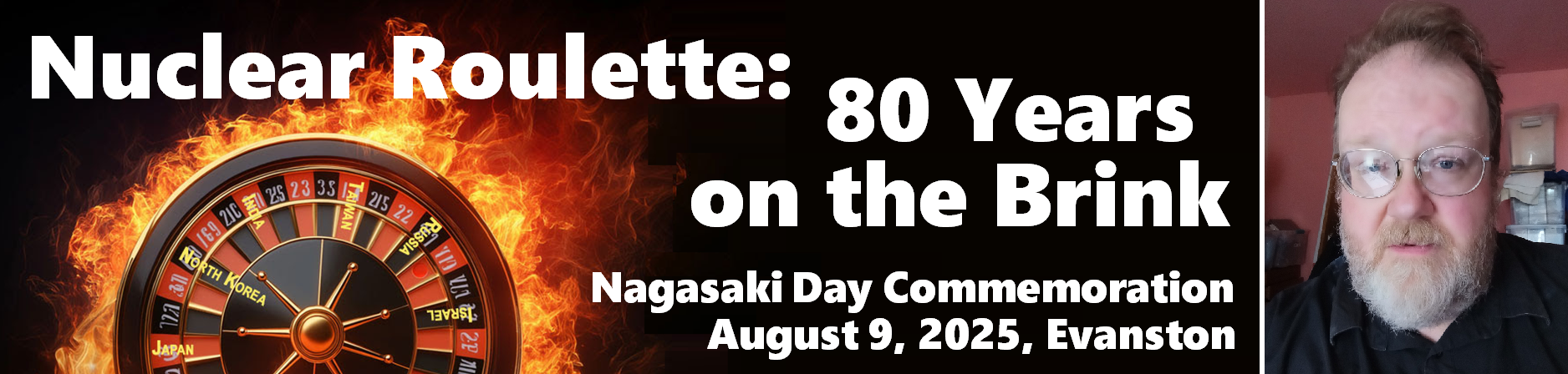
Chicago Antiwar Coalition (CAWC) statement to the commemoration in Evanston of the Aug 6 and Aug 9, 1945 U.S. Gov’t atomic bombings of Hiroshima and Nagasaki – Neal Resnikoff

Neal Resnikoff is a long-time Chicago peace activist and spoke on behalf of the Chicago Antiwar Coalition.

The U.S. government is continuing its imperialist war against Russia. It is doing so with the President heavily using the power of that position, as other presidents before him have done.

The U.S. government is continuing to use Ukraine as its proxy and NATO as a conduit for arms to fight the Russian military self-defense forces, Trump has ordered U.S. nuclear submarines off the coast of Russia.

The U.S. government also has continued its policy of being willing to use nuclear weapons it has in bases in Europe and elsewhere on a first-strike basis.

The Russian government, realizing the current threats, has now declared it is removing its self- imposed restraint on deploying mid-range missiles.

The situation is extremely dangerous, with increased threat of nuclear war, but there has not been big attention and debate about this.

Meanwhile, the U.S. government is complicit in the horrendous genocidal massacre of over 60,000 Palestinians so far.

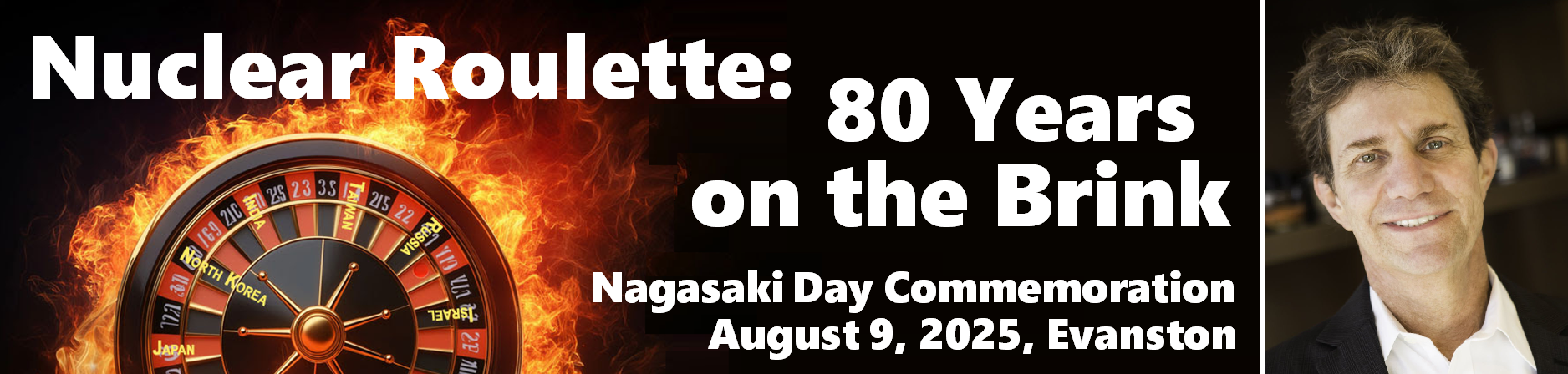
This all comes in the wake 80 years ago today of the U.S. government atomic bombing of Nagasaki in Japan. The atomic bombing of Hiroshima was August 6, 1945.

These were U.S. government war crimes that killed hundreds of thousands of civilians and injured hundreds of thousands more.

Since then the U.S. capitalist ruling class, using Democrats and Republicans, has illegally and unjustly killed millions more in other countries around the world, using other kinds of weapons, though including depleted uranium weapons.

The U.S. government actions have all been to suppress opposition or to beat back competition for raw materials, labor power, and markets from other countries. The aim is to ensure maximum profits for the big U.S. banks and big corporations. These ruthless acts of U.S. imperialism are usually covered over by some noble sounding justifications.

Noble sounding justification was true in in the U.S. government atomic bomb massacres in1945, and there is still promotion of the U.S. government lie that this was a move to save the lives of American troops by bringing a quick end to the war against Japan. For example, Trump said on June 25 at the NATO Summit that the atomic bombing of Hiroshima and Nagasaki “ended that war.” President Obama said in a speech in Hiroshima in 2016 that “World War Two reached its end with Hiroshima and Nagasaki.”

These are lies that have been exposed as lies. For example, General Curtis LeMay said two weeks after the end of war, “The atomic bomb had nothing to do with the end of the war. The war would have ended in two weeks without the atomic bomb.” Admiral William Leahy, who was President Truman’s Chief of Staff said “The use of this barbarous weapon at Hiroshima and Nagasaki was of no material assistance in our war against Japan. The Japanese were already defeated and ready to surrender.”

U.S. Secretary of State James Byrne said at the time: “If we could end the war before the Red Army got to Manchuria and then Japan, we could dominate the situation in Japan and probably Manchuria.” Secretary of War Henry L. Stimson also exposed the aim of the atomic bombing: “It [the atom bomb] was the master card … over the Russians.

The atomic bombing happened after it was already clear to the U.S. government that the Japanese government was ready to surrender in World War II. This was known because the U.S. had broken the Japanese codes, and the Japanese were negotiating surrender with the Soviet Union.

The dropping of the atomic bombs had the pernicious aim of trying to frighten others in Asia and open the door for U.S. imperialism to dominate Asia and the world.

We have the responsibility to take out the lessons of this ruthless killing to as many people as we can, because today the U.S. government is still massacring people, directly and indirectly—such as through the war in Ukraine that the U.S. instigated by provoking Russia into military action. And it is threatening nuclear war against Russia, and others.

The U.S. has been provoking China by interfering in Taiwan, long part of China, with arms sales, training of military personnel, adding U.S. naval presence in the area, and encouraging steps within Taiwan toward independence from China. China has been opposing this with various statements and exercises preparing for a possible military invasion of Taiwan. President Biden declared the U.S. government would defend Taiwan militarily if China invaded, and Secretary of State Marco Rubio reaffirmed that U.S. government policy remains one of opposition to forced changes in Taiwan’s status.

The U.S. government is still the world’s greatest perpetrator of nuclear proliferation, and threatening its use.

The solution to the rampages of U.S. imperialism is the complete dismantling of the U.S. imperialist war machine and its nuclear terror apparatus.

How about if we take up these slogans:

No More Hiroshimas and Nagasakis!

No to the Use of Force to Settle Conflicts between Nations!

Dismantle NATO!

All Out to Organize an Anti-War Government!

Urgent, Fresh Looks At The Importance Of August 9 Hiroshima And Nagasaki Day Commemorations – Jack Lawlor

Jack Lawlor is a member of CAPA’s Foreign Policy Working Group and the Chicago Chapter of the Buddhist Peace Fellowship

Within a few months after the atomic bomb attacks against Hiroshima and Nagasaki, 31 year old war correspondent John Hersey went to Hiroshima, interviewed survivors, and wrote a series of stunning articles for The New Yorker we know today as his book, Hiroshima. The book does not treat this first use of atomic weapons as an abstraction; instead, it personalizes the nature of the resulting individual suffering to six survivors caused by the attack in ways left unexplored in the recent movie, “Oppenheimer”. For many years, the book Hiroshima became mandatory summer reading on some high school summer book lists. The book moved me as a high school freshman to question my complete pro-American bias and inquire about how to protect humanity and the earth.

The commemoration of the Hiroshima and Nagasaki atomic attacks is more relevant than ever, because we have not learned all that we can from them. President Putin of Russia has been frequently threatening to use tactical nuclear weapons against Ukraine, a step which would lead to horrible consequences. He is already using hypersonic weaponry against Ukraine, another unprecedented escalation.
What can we as citizens do to protect ourselves, our descendants, the earth? We need to join hands together and make international discussion of this issue much more of a top priority.

I wish we could see an arc of progress in efforts to regulate nuclear arms. But the arc is going in the wrong direction:

1
For all practical purposes, there are no longer effective arms control treaties in effect between the US and Russia. They have expired or are expiring. The New START Treaty expires in five months, on February 25, 2026. Russia has suspended its participation but has not withdrawn from the treaty, which successfully achieved verifiable large reductions in the number of US and Russian nuclear weapons to about 3,000 each. If New START is not renewed, and if China is not involved, the US may feel compelled to exceed the New START limits due to China’s nuclear weapons buildup. Also, both the US and Russia have walked away from the 1987 INF Treaty, which sought to eliminate intermediate- range nuclear missiles.

2
There are now at least nine countries with nuclear weapons, stockpiling 13,000 of them.

3
There have been UN resolutions pledging member countries to forego first use of nuclear weapons. This is an admirable effort, but its legal effectiveness is questionable and the nine nations who possess nuclear weapons either haven’t signed or privately feel free to violate the treaty. The 1990 treaty on the non-proliferation of nuclear weapons (the “NPT”) has limited the number of states possessing nuclear weapons, but this success may end soon if Iran and other countries proceed vigorously to obtain a bomb in the wake of the recent Israeli/US attack on Iran and in the wake of concerns about the reliability of America’s nuclear umbrella.

4
US peace and justice groups have been pushing hard for the US to forego first use of nuclear weapons, but the legislative resolutions stall in a toxically divided Congress pre-occupied with elections and culture wars.

5
Peace groups’ efforts have tried to regulate the US president’s authority to authorize a nuclear attack. Apart from verifying that the order to launch comes from the President, US protocols do not require discussion or review of the order to attack by any other US official. This is dangerous if autocratic or unstable individuals occupy the Oval Office. Senator Tim Kaine’s recent effort to regulate the President’s authority was recently defeated in a 53-47 vote.

6
As you can glean, a new nuclear arms race may begin imminently. The cost to refurbish the US Sentinel land-based missile system ALONE has escalated to 140.9 billion dollars. Plus, President Trump has just announced his interest in a new Golden Dome system akin to President Reagan’s Star Wars defense system, likely triggering a costly Anti-Ballistic Missile arms race.

What can we do?

I suggest that we don’t assume that the US public is very familiar with any of this, and begin a dialogue that uses plain language to demonstrate the need to avoid future Hiroshimas and Nagasakis. People can be encouraged to:

a.
learn more about the situation, using resources such as Nuclear Disarmament and Arms Control magazine;

b.
let’s work together to support pending House Resolution 317, the so-called “Back from
the Brink Resolution”, which calls for the US, Russia, China, and all other nuclear-armed states to (1) reduce their arsenals, (2) renounce first use of nuclear weapons and hair-trigger alert postures, (3) maintain a test ban, and (4) renew the New START Treaty; and

c.
above all, join with other people in your community through groups such as Chicago Area Peace Action. You’ll learn a lot from others and they will appreciate your insights and talents. Seasoned groups know how to work with elected officials and their staff members, elevating the effectiveness of your efforts enormously.

Let’s ponder all this with the curiosity of a young John Hersey and work together to prevent other Hiroshimas and Nagasakis.

Trump to Ukraine: ‘Squander another half million casualties to prevent defeat on my watch’ – Walt Zlotow

Walt Zlotow blogs at heartlandprogressive.blogspot.com/ and serves as president of Chicagoland’s West Suburban Peace Coalition. CAPA is grateful to him for permission to repost his essay.

Most esteemed observers put Ukraine’s dead and wounded at north of a half million in their lost war with Russia. Several million young Ukrainian men have fled conscription while stragglers are rounded up like stray dogs to be thrown into the meat grinder of warfare they’re totally unprepared to fight.

But the war is much more than Ukraine defending itself from a Russian invasion. It’s America’s proxy war to weaken, isolate Russia from Western European political economy. Its origins go back 17 years when the US pitched NATO membership to Ukraine to achieve that senseless goal. It virtually guaranteed war after the US engineered the 2014 coup against Russian friendly Ukrainian President Victor Yanukovych. It ignited a civil war between the Kyiv government and the Russian cultured Ukrainians in the Donbas on Russia’s border. Russia tried diplomacy for 8 years to no avail before invading both to keep Ukraine out of NATO and end protect the beleaguered Donbas Ukrainians. Just before the invasion the US stupidly told Russia that NATO membership for Ukraine and Russia’s security concerns were not subject to diplomacy.

America’s best laid plans to prevail failed spectacularly. Now Ukraine will never join NATO but Donbas Ukrainians are largely safe and thrilled to be under Russian protection from the terrors imposed by Kyiv. Ukraine’s fate was sealed once Biden announced he’d only waste US treasure for weapons but not one drop of US blood for Ukraine’s defense. Three and a half years and over $200 billion in US/NATO weapons have simply put Ukraine on US/NATO life support.

Biden was able to keep Ukraine in the fight for nearly 3 years, squandering a half million of its finest, so he could pass the war on to successor Trump. After being eviscerated by the US national security class for his admitting defeat and withdrawing from the 20 year Afghan war, Biden was loath to incur another defeat on his watch. So he loaded up Ukraine with tons of weapons in his last months to ensure Ukraine would not collapse before his leaving.

Even before retaking office, clueless Trump bragged he’d end the war in one day. He tried to browbeat Ukraine President Zelensky to negotiate war’s end, even humiliating him before the world in the Oval Office. One hundred seventy-five days in Trump is facing his own Afghanistan style defeat as Ukraine nears collapse.

To stave off impending defeat he reversed the Pentagon’s withdrawal of new weapons based on US stockpiles running low. But all he could sputter was that he’s releasing “defensive weapons” only which will do no good with Ukraine running out of cannon fodder to fire them.

For Trump that’s A-OK. ‘Fight on Ukraine…I’ve only got three and a half years to keep this going till I can pull a Biden and pass it on the next clueless idiot trying to defeat an undefeatable Russia.’ The real issue is not whether Trump will succeed. He can’t. The ominous issue facing the US, indeed peoplekind, is whether Trump’s plan to avert defeat will lead to nuclear war that has been a possibility every day in Ukraine for the past three and a half years.

Walt Zlotow, West Suburban Peace Coalition, Glen Ellyn IL

Letter to Ha’aretz Newspaper

Catherine Buntin is CAPA’s President.

From an American Nurse

We have done everything possible to protest our government sending weapons to Israel to no avail.

The only hope for stopping this genocidal war sits in your hands, the people of Israel.  You can organize to say “Not in our Name” to Netanyahu and your extremist right wing government. 

So far, the only protests in Israel have been organized around the remaining Israeli hostages.  While that may be understandable, it is not the whole story while over 2,000 innocent Palestinians languish in your tortuous prisons.  They too are hostages, and they are voiceless.

The Jewish faith does not condone ethnic cleansing.  Your care and your voice must bring down this government which would annihilate another people.  Hamas has said it fights to end the occupation, for their people to be free. They will not lay down their arms any more than Israel would lay down its arms.  This appears to be a war of racist intent, one of white superiority. A war of power over the powerless and for a major land grab.

Killing civilians is a war crime, be it 120 innocent or 50,000 innocents.  Hamas was wrong and what Israel has done is unconscionable.

Netanyahu does not intend to ever allow a two-state solution.  He has demonstrated his intention of stealing land from several of your neighbors, including Lebanon and Syria, and Gaza and the West Bank, to create the “Greater Israel”.  He is proud to show his new map of the future.  I must ask, do you condone this? 

He has also demonstrated that he will execute, at will, any leaders in other countries. Is this the world we want to live in– a lawless world where tyrants can take you out with drones from the sky, while you sleep?

The slaughter in Gaza is inhumane and the Israeli soldiers who have killed and maimed these people will live out their lives with deep emotional and spiritual scars. And how will the world see Israelis from now on?  Will they care about your history, your pain, your suffering?  Hardly. You have no moral ground to stand on now and neither do we, we who have supplied your bombs.

There are starving people next door to you.  I weep—even want to scream—for the beautiful children starving and dying a painful death.  And for their parents. Please care enough to bring down your government–  You can stop this war.

M. Catherine Buntin, RN, MS, MPH

An Illness and a Health Breakthrough – Charles Johnson

Charles Johnson is CAPA’s Organizing Director.

We the masses in the U.S. are enabling a deadly illness. This illness originates from those in power, who actively spread it to the masses. Rampant throughout U.S. policies and narratives, this illness is “using force to gain and maintain power and control.” The epicenter of this illness is the U.S., under both Democratic and Republican leadership in coordination with corporate leaders. Effects of this illness harm the masses worldwide the most, as well as the masses in the U.S. – and the masses in the U.S. widely uphold and enable this illness. 

In fact, we the masses in the U.S. can help break through the illness, to bring about recovery and health – but how? Breaking through the illness could require the masses in the U.S. to leave behind a widespread belief system, the belief in using force. Upheld by disproven myths, the belief in using force resembles a cult, where a few leaders who benefit convince followers to uphold the belief system. We the masses consent to it, hoping for some benefit. Some signs of our consent include serving in and supporting:  

1.) Regional military alliances, like NATO.  
2.) National militaries, like the U.S. military. 
3.) Armed police forces/ local armed forces, like the Chicago Police Dept. 

 Support for the above is common among the masses in the U.S., including among those working for peace. We may think: “Without police forces, who would keep us safe?” And even if we aren’t personally in the military or police forces, we may think that these forces are at least partly needed, that they keep communities safe, that they help maintain order, that we could never totally eliminate them. We may think that there are no better alternatives, or that these alternatives have no answers to dilemmas like the “home intruder”, the “armed psychopath”, “organized crime,” “Hitler,” and so forth. 

In reality, alternatives and answers to these dilemmas are abundant. Lack of awareness of these alternatives and answers is similar to lack of awareness of cures for an illness — “there must be no cure” — rather than researching cures, testing them, and improving them. And there are already many well-tested cures to the illness of using force. A health breakthrough could involve a rapid, mass shift of thought away from the belief in using force, toward cures. Given the masses’ current belief in using force, and lack of awareness of altenratives, such a health breakthrough may seem highly unlikely. 

We may think – “a health breakthrough sounds nice, but the powerful won’t allow it – they’re too addicted to power and resources – they’re too successful at using capitalism and militarism for their goals. They can silence and kill off any alternatives.” Even so, the powerful need us, the masses in the U.S., to support and staff the militaries and police forces deployed by the powerful. We the masses in the U.S. do it for them, protecting their growing concentration of power. 

Often, those of us who support a move toward alternatives can’t manage to convince others to make a similar shift. How could peace-workers move public opinion away from the belief in using force? How could we do it rapidly and massively? A first step could be increasing our knowledge of these alternatives – not just knowing the alternatives’ names, but how they work in practice. We could learn how to easily explain these alternatives to others, with a few real-life examples and tactics. A second step could be convincing ourselves and others to no longer support or join armed forces – and to support and join alternatives instead. At 3 levels, this could include promoting, supporting, donating to, or joining:

1. Instead of military alliances:  non-coercive international coalitions 

2. Instead of militaries: unarmed civilian protection teams

3. Instead of police forces: community violence intervention teams

We may think that these ideas are “nice,” but not really a practical reality. Such a health breakthrough catching on may seem “unlikely any time soon”. This is especially true if we are still caught in the illness. Although wanting to leave the belief in using force, we may consider it impossible “at the current time”– like those who want to leave a cult, who’ve set our minds on leaving it, but are afraid to make the break: “Let’s wait until it’s safer to leave.” But waiting for the right time tends to prolong the time of leaving. The right time to leave could be right now. 

We Don’t Want Hands Off NATO!

(Many of us at CAPA were glad to recieve this correction from our friend Nicolas Davies, who asked us, on behalf of antiwar allies World BEYOND War” and “CODEPINK,” to publish this note due to its great timeliness and urgency. We’ll be out this Saturday in support of democratic government, but not necessarily in support of the U.S. and Europe’s military dominion of our planet, than which (however short of true democracy the U.S.’ rivals may fall) there might not be many things less democratic. – Viewpoints Ed.)

By World BEYOND War and CODEPINK, March 30, 2025

We are passionate supporters of all but one of the items on the Hands Off agenda: NATO. We couldn’t agree more that the corrupt U.S. government should stop destroying, privatizing, firing, and giving away the post office, schools, land, Social Security, healthcare, environmental protections, and all sorts of essential public services. But we are deeply disturbed to see NATO on the list of items we are trying to protect.

Many people believe that NATO is a peace-loving, defensive alliance, but the opposite is true. During the past 30 years, NATO has fomented a vast arc of violence stretching from Libya to Afghanistan, leaving villages bombed, infrastructure destroyed, and countless dead.

Originally formed to deter Soviet aggression, NATO not only failed to disband with the fall of the Soviet Union, it increased from 16 members in 1991 to 32 members today. Despite promises not to expand eastward, it ploughed ahead against the advice of senior, experienced U.S. diplomats who warned that this would inflame tensions with Russia. While Russia bears full responsibility for invading Ukraine, in violation of the UN Charter, we cannot deny the disastrous role played by NATO in provoking and then prolonging the war in Ukraine.

The inclusion of NATO in our demands contradicts the basic Hands Off agenda. Right now, at the bidding of President Trump, NATO is openly and aggressively pressuring its member nations to move money from healthcare, retirement funds, and clean energy to weapons and militarism.

We would be happy to expand the Hands Off demands to international issues, such as Hands Off Palestine or Yemen or Greenland or Panama or Canada. But we do object to including a destructive institution like NATO, an institution that systematically and grossly violates the commitment to settle disputes peacefully contained in the UN Charter. If we are truly committed to human needs and the environment, as well as peace, diplomacy and the UN Charter, then we should eliminate NATO from our Hands Off agenda.

Trump’s Talk About American Exceptionalism is Dangerous – Jim Huffman

James Huffman, a CAPA activist and Board and Executive Committee member, is the Hirt professor of history emeritus at Wittenberg University and has published nine books, including “Japan in World History.” The following piece appeared as an Op-Ed in the March 21st Chicago Sun-Times with the subheading: “Triumphalist rhetoric like what we’ve heard from the president makes it impossible to see things, including ourselves, as they really are. And that invites disaster, including war.”

_____

President Donald Trump loves to tell us how great America is. “There is no nation like our nation,” he said in his inaugural address. “No one comes close.” In his recent address to Congress, he said America will “forge” the “most dominant civilization ever to exist on the face of this Earth.”

Look more carefully, however, and it becomes clear that the exceptionalism that drives his talk is more dangerous than hopeful.

Asked to identify today’s greatest threats, many people would cite the wars in Israel and Ukraine; others would talk about climate change. But Trump’s endless boasting about our near-universal belief that America is exceptional is as dangerous as any of these. Probably more so.

Many other “certainties” have lost their hold on public thinking in recent decades: ideas about climate change, race, abortion, LGBTQ+ rights. But the belief that Americans are an exceptional people, called to lead the world, remains unassailable.

Liberals and conservatives alike still accept John F. Kennedy’s declaration in his 1961 inaugural address that we are the “shining city on a hill,” destined to defend the world against forces of evil.

One reason for the persistence of that conviction is the endless repetition of Puritan John Winthrop’s 17th century sermon from which JFK — and later Ronald Reagan — drew this image. By the 19th century, the “city on a hill” trope had taken root; by the mid-1900s, it had become doctrine.

Another reason is spiritual; it feels good to be superior. The Guardian columnist George Monbiot wrote that “the United States is … a religion,” peopled by those who see themselves called by God to lift others “from their darkness.” Another British journalist told a class of mine that America is not a “country” bound together by a common past, but an “ideology,” with people united by documents like the Constitution rather than by geography or a shared past.

So how can a belief that serves so many groups so well be dangerous?

The fundamental answer is simple: Exceptionalist thinking is based on false premises, which blind us to our frailties, make it hard to understand how the rest of the world sees us and prevents clear-headed decision-making. They enable the arms industry to do its work largely undetected, or at least unchallenged, and render practical diplomacy difficult, sometimes impossible. And those very things invite serious mistakes, and war.

Simplistic policies make tough situations harder

History provides endless examples of exceptionalist beliefs causing disaster. As a historian of Japan, I shiver when I read the 1920s speeches of the military intellectual Ishiwara Kanji, who believed that because Japan was superior, the kami, or gods, had willed it to win humankind’s “final war” and usher in a millennium of global prosperity. It was a short step from that belief to Pearl Harbor.

Shortly after World War II, a similar story, with Communists as the villains, prompted the United States to support a massacre of perhaps 30,000 people in Korea’s southern island of Jeju while the media looked away. In the decades that followed, exceptionalist readings of America’s moral position led us to depose regimes in Iran (1953) and Chile (1970) and launch disastrous wars in Vietnam and Iraq.

Today, the myth underlies simplistic good guy-bad-buy policies in the Middle East, Ukraine, and Asia, policies that make nuanced solutions to complex situations forbiddingly difficult. Ultimately, such thinking grows ever more likely to ignite nuclear war in any of those regions.

The point of this is not to say America should withdraw itself from the world’s danger zones, nor that it should stop being a force for good.

It is to make it clear that triumphalist rhetoric makes it impossible to see things, including ourselves, as they really are. And that invites conflicts that kill people — by the tens or hundreds of thousands.

Can the narrative be changed? Can we learn to see ourselves and others in the nuanced, honest ways necessary for peace? I am not optimistic. But the long-term survival of humankind depends on it. If we do not take up this conversation now, we may not get another chance.

Official White House Photo by Joyce N. Boghosian

Lesley Williams “Pursuit of Peace” Award Speech

On October 17 of last year, CAPA was honored to award local activist Lesley Williams our “Robert Cleland Pursuit of Peace Award.” Lesley is a community advocate and activist for racial justice both locally and globally. In her hometown of Evanston she has served as president of Open Communities, a HUD-certified fair housing organization, and the Community Alliance for Better Government, which pushes for transparency and racial justice in city services. She has previously served on the boards of Family Matters in the North of Howard area, the Evanston United Way, and Interfaith Action of Evanston.

We thought it was time to share the wisdom of her acceptance speech with you.


—–

“Thanks to the committee and the board and to all the inspiring activists and advocates I’ve worked with in Jewish Voice for Peace, the Center for Jewish NonViolence, Evanston Ceasefire, Open Communities, and the Community Alliance for Better Government . I am here because of all of you.

“When I was in grad school, several of my friends used to go dancing Friday nights at a local club. Nothing fancy, just loud music, cheap beer and a big dance floor. One semester a group of very large guys (okay, they were from a frat) started turning up and commandeering the dance floor. Every week they would arrive, nod to each other and start performing a very aggressive version of the electric slide: arms pumping, elbows effectively pushing anyone and everyone who wasn’t in their group off the floor.

“People muttered a bit. But no one challenged them, including the managers. Most of the crowd would just give up and retreat when these guys arrived. 

“But I kept dancing. The guys would shout their trademark “Boo yah!” the warning for everyone to clear the floor, but I kept dancing. Elbows would fly toward my face, shoulders would be shoved into my back, but I kept dancing. At times it probably looked sort of like the Roxbury guys from Saturday Night Live, but I kept dancing, holding my space, refusing to be intimidated by a group of posturing jerks. And little by little, other folks started to come back to the floor. Other folks started to dance with me, our determination the solid rock that forced that wave of commando dancers to break. And eventually, the frat stopped coming to the club. It didn’t happen right away, it took several weeks but eventually the dance floor was open to everyone yet again.

“This for me is quintessential activism: being that small immovable rock that the waves of fascism, racism, and sexism break over. It doesn’t have to be loud and showy. It can be the quiet determination of a Rosa Parks, or the Sumud, the steadfastness of Palestinian teens dancing debka amidst rocket fire in Gaza.

“A few things I’ve learned along the way.

Being an activist is NOT the swiftest route to popularity. Quite the opposite in fact. During my checkered career I’ve been called arrogant, ignorant and uppity. I’ve been accused of elitism, reverse racism and antisemitism. I’ve been the angry Black woman and the self-hating Jew. And I’ve been told I have no team spirit. (sigh)

“But I’ve reminded myself of two things. First, you lose a lot more battles than you win, but this isn’t a reason to stop fighting. Second, every person who has actively made a difference in the world was hated by someone at some point. And they’ve all probably thought they were failures, and that they weren’t making a difference. I know I have. Near the end of his life, Martin Luther King was one of the most unpopular people in America, not only due to his racial justice work but because he also spoke out against the Vietnam war, and was making powerful friends uncomfortable. But he knew that principles were more important than friendships, and if he had to lose friendships to stop an unjust war, then so be it. 

“Now there’s no way I’m going to compare myself to MLK, but that’s another thing I’ve learned…

Being an activist is hard but living with oppression is harder.

“It’s very easy to get self righteous about our activism, “Aren’t we such good good people!” Aren’t we heroic! Look at our noble sacrifice!” But true activism doesn’t center activists, it centers the people being impacted. And it requires the humility to admit that sometimes we activists don’t have all the answers, and we need to listen to the people we think we’re helping. We need to admit that we make mistakes; that we make racist or classist assumptions, that we misgender people, that we sometimes talk down to people. I’ve done it; you’ve done it. True allyship demands this humility, the willingness to listen, and to make amends when we screw up.

Most important of all we have to insist on justice in every aspect of our lives.

“This means living as though the lives of those on the other side of town, the other side of the world are as deserving as our own, that their children deserve the same care and opportunities as ours.

“There is an ethical principle in the Talmud loosely translated as “is your blood redder”. A commentary tells the story of a rabbi counseling a grieving father whose son was scheduled to be exterminated at Auschwitz. The father could bribe a guard to release the boy but that would mean another child would be selected to take his place. Was it permissible for him to do this? The rabbi merely responded “Is your son’s blood redder?” The father bowed his head and asked the rabbi to help him say Kaddish, the prayer for the dead, for his beloved son.

“Admittedly this is an impossible standard. I doubt that any of us would have made the same choice as that father; I know I wouldn’t have. But we must continue to ask ourselves: when we insist on the best for our families, our communities, our country, are we dooming someone else’s children to the worst? Does our need for safety justify policing and militarization that makes others demonstrably unsafe? Does our need for faster, more sparkly technology; for more oil, and cheaper clothes, justify sweatshop labor, techno waste, and devastating chemical exposure for those half a world away? Do we truly value excellence for all or only for a few? A high standard of living for ourselves, or an end to poverty and misery for people we don’t know?

“Is our blood redder?

“Like that father we have choices. Most of us in this room are fairly privileged, and the choices we make have powerful consequences for those we may never meet. We can choose to live isolated, privileged lives, or to engage. We can choose to distance ourselves from poverty and crime and suffering, or we can work in solidarity with those whose options are limited.

“We utter a lot of platitudes about equity and compassion and peace, but really all of these come down to justice. It is unjust that those suffering most from climate change are not the ones indulging in fossil fuels and overconsumption. It is unjust that Black children living on one side of the Dan Ryan have worse schools, fewer grocery stores and shorter life expectancies than those in Oak Park. It is unjust that people with bodies that don’t match their gender identity suffer abuse and higher rates of murder and suicide. These may all seem like different issues, but they can all be addressed by demanding justice, and by creating policies that put justice first.

“This requires courage, but also honesty. It is very easy to allow ourselves to ignore injustice, to listen to the comforting cynical reassurance that “climate despair is overstated”, “these people could succeed if they worked harder”, this situation is “too complicated” “too intractable”; the solution “too inconvenient”. Change is hard; justice is hard; it requires sacrifice and commitment and persistence. We don’t like to hear that; we don’t like to hear that we may have to pay higher taxes to support other people’s children, that we have to pay full price (including shipping)! to give working people a living wage, that we need to eat less meat or limit our air travel to protect our environment. We resist giving up privileges we have come to see as rights. We prefer soothing nostrums about “individual responsibility” and organizing canned food drives rather than confronting systemic injustice.

“We need the courage and honesty to speak hard truths; to ignore those seductive little lies from colleagues and lobbyists, but also on sitcoms and at church; from friends at the country club and the neighborhood association, from Cousin Bob and Aunt Louise at Thanksgiving.

“Yes, it’s complicated. It’s always complicated . But complication is not an excuse for disengaging; it’s a call to engage more fully. Yes you may make mistakes. Yes you may be inconsistent. But it is better to be inconsistently moral than consistently cruel.

“And we have no right to give in to despair. My husband once told me that I might never live to see Palestinian liberation or the end to systemic racism or transphobia. And I have to be okay with that. Because being an activist means seeing yourself as part of the chain that keeps the struggle going forward, even if you never see the result. In his final speech, MLK acknowledged that while he might never get to the Promised Land, he had faith that we as a people would. This is not blind, candy colored optimism: this is hope, born of struggle, born of sumud, born of faith in the next generation. Keep the chain going. Breath your hope and your dreams into the future. And let’s make room on the floor for everyone to dance.”

Re: the Trump-Zelensky Break

by Sean Reynolds, CAPA activist

This past Saturday I was pleased to appear, flatteringly labeled as a “Political Analyst” (are any of us not political analysts?), in a segment on Iran’s PressTV, interviewed by journalist Ramin Mazaheri whose three brilliant, vexing books I should admit I’d benefited greatly from reading years earlier.  On CAPA’s Viewpoints page, we try not to link to state-sponsored or otherwise high-end broadcast media (and nearly all mainstream media, we’ve learned of late, does seem to be state-sponsored) but the piece is easily googleable searching Ramin’s name plus its title: “Trump Kicks Zelensky out of White House After Historic Press Conference.” It had been quite the day.

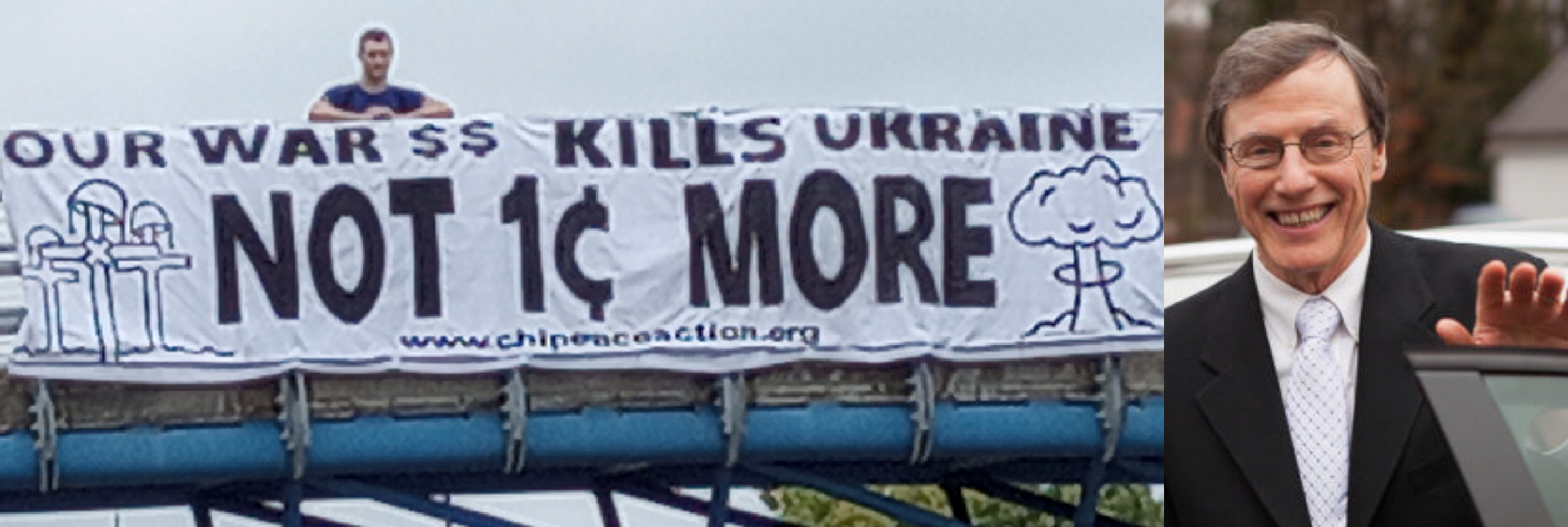
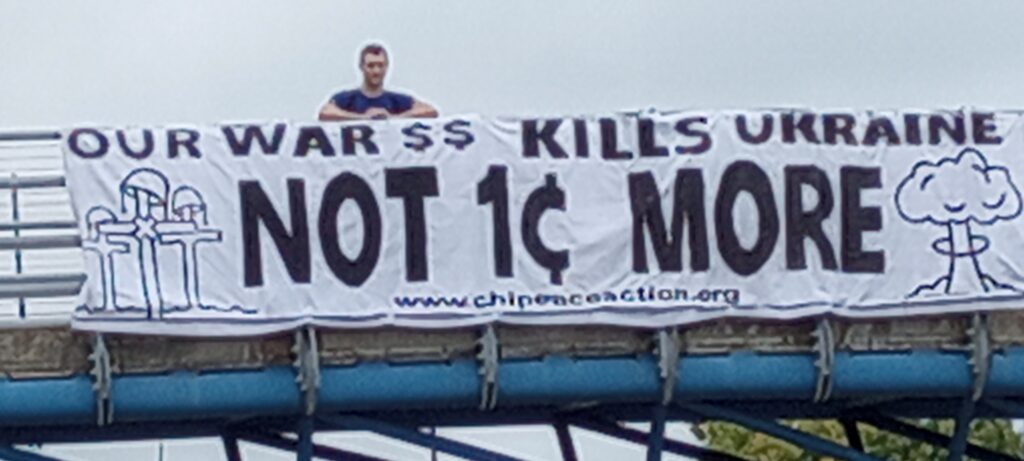
Alongside CAPA, I’d long waited, and vigorously called, for the moment that U.S. military aid to Ukraine’s Kyiv government would cease – on highway overpasses countless mornings in Chicago I’ve helped raise the banner pictured below – so that Ukraine could escape being sacrificed to the U.S.’ economic rivalry with Russia and Russia’s ally China, but also that the world might escape the unforgivable nuclear risks created by a de facto, and now blessedly ending, NATO-Russia hot war: in my final minutes of life, walking downtown to calmly meet the birth of a tiny new short-lived star, I won’t want the blood of the entire species on my hands – I trust that you won’t either – nor has their ever-more-parchmenty complexion improved at all in recent years from their incessant, inescapable dousing in Ukrainian and Russian blood.

You’ve heard it all before and I would also hope you’ve read it in books like Scott Horton’s “Provoked” or the late Stephen F. Cohen’s magisterial “War with Russia?” (maybe go find them now: also indispensable foreign policy analysis channels such as “The Grayzone,” “The Duran,” “Dialogue Works” and the goofily-titled “Judging Freedom“) …  but let me risk the bizarrely – and from a democracy perspective, terrifyingly – common objection that foreign propaganda is the type to which Americans are most susceptible (if not uniquely so), by going through it all briefly, one more time:

  • In 2014 we helped orchestrate a well-funded coup ousting Ukraine’s elected president using neo-Nazi militias who, thereafter, had a strong role in preventing any peace organizing or consequential elections in the country.  The country’s ethnically Russian East found itself caught in a U.S.-instigated race war and spent eight years fighting to secede and rejoin the Russian state from which Lenin and Khrushchev had parceled it off in the Soviet era. Russia obeyed the overwhelming preference of Crimeans and more crucially its own realpolitik interests, by immediately reabsorbing the Crimean peninsula and a crucial naval port: but it spent eight years negotiating for the Donbass region to remain, with structural protections, in Ukraine, preferring to avoid a war. 
  • in 2022, after two rounds of “Minsk accords” by which Ukraine, France and Germany all admitted they’d never intended to abide, Russia made a final plea for NATO to swear off expansion into Ukraine and met with blank refusal: then it recognized the breakaway Donbass provinces as sovereign states in whose aid it would move troops to repel Ukrainian occupiers.  A final opportunity for negotiation was lost after Ukrainian negotiators, under pressure of a Russian feint towards Kyiv, had penciled the “Istanbul Agreement” leaving Donbass in Ukraine but giving Russia guarantees against NATO encroachment.  Our leaders scuppered the deal demanding that our client in Kyiv fight this war to the last Ukrainian. 

And here we are!

Ukraine never had a chance of winning the war against its far better armed and more populous neighbor, but it was never meant to: NATO officials have routinely boasted of the “bargain” the West is getting, weakening their Russian, hence also their Chinese, rival with only scores of thousands of dead or wounded Ukrainians (and Russians, of course), along with Ukraine’s radically diminished future prospects, as the cost.  

So when I gave that interview, I was overjoyed at the break of relations between the new administration and Mr. Zelensky: I still am.   I’m more inclined to think, a few days after the interview, that the two American leaders might sincerely have been trying to pull Zelensky towards good-faith negotiations with Russia, with no ambush prepared beforehand as a nonetheless invaluable teaching moment for the most peace-minded U.S. citizens: but given what seems Zelensky’s fundamental opposition to any such negotiations, a brawl, planned or unplanned, is probably the best outcome that could have resulted from the meeting. U.S. support for a perpetual Ukraine war, waged to Ukraine’s and to the world’s incalculable cost, seems finally, blessedly, miraculously, to be at an end.  If only our support for (and our imperial exploitation of) Israel’s violence would follow suit!

Fascism and democracy are words that actually matter: forcing working majorities to live by, and never even criticize, the edicts of their ruling bureaucracies has become, for the more unapologetically pro-war in my own country, the very definition of democracy, whereas for many of us, including much of the nation’s more conservative half, it still sounds like the other thing.   Although, as an antiwar socialist who’s spent two daylong stints in jail protesting Israel’s Gaza genocide, I would have liked, being in a “safe state,” to vote for a third party this past November, the 2024 stakes felt, to me, too high not to make a lesser evil vote (and – I confess – even a lesser evil donation) on antiwar grounds.  

I was very grateful this Saturday that the candidate I’d helped elect a few months prior had (for motives I might not even like if it were possible to know them) begun this process of seeking survival for the species, peace for Ukraine, and a distinct lessening of war-fevered ignominy for the United States. 

Chicago Tribune LTE March 3 – “Dangerous Conflation”

This Letter to the Editor, published March 3, is from the CAPA Climate Change Working Group’s own Carter Cleland.

The editorial about the puppet at the Chicago Cultural Center opens up a new, and dangerous, conflation (“Antisemitic fears in Chicago coalesce around a controversial puppet,” Feb. 19). The Tribune Editorial Board indicates that “blood on your hands” is an antisemitic trope. I could find no instance online in which that expression was particular to Jews or Judaism.

As an non-Jewish, American taxpayer, I do have the blood of 48,000 Palestinians on my hands because I helped pay for the bombs that killed them all and that maimed many, many more.

I would suggest that the many Jews and gentiles who oppose the war in Gaza, as well as the 23 aldermen who didn’t sign Ald. Debra Silverstein’s letter, might not like being labelled antisemitic.

— Carter Cleland, Chicago

09.22.19

40th ANNUAL