
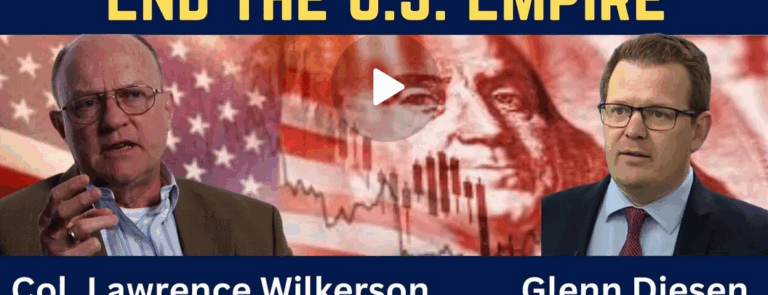
This response to Diesen’s and Wilkerson’s interview (listenable here) is by Sean Reynolds, an activist in CAPA’s Foreign Policy Working Group.
Years ago, before the Soleimani assassination and before COVID, I got to tour Iran’s capital of Tehran, and Isfahan, its chief tourist city, with CODEPINK. An Iranian woman who’d befriended us asked whether the U.S. was going to bomb her (a question I was also posed by the priest at an historic Armenian Orthodox church). One of my fellow delegates told my new friend that the U.S. would never risk shutdown of the Strait of Hormuz and a resulting global economic collapse. He left the table and another delegate sadly insisted the U.S. was paralyzed by neocon ideology and that a U.S.-Iran war was likely. I myself told the woman she was now my friend and so I would try not to kill her – which I’m still trying, with small activist measures like this essay, to keep from doing. I’m put in mind of all of the above by Professor Glenn Diesen’s recent hour-long interview with Retired Colonel Lawrence Wilkerson, former Secretary of State Colin Powell’s chief of staff and a treasured go-to voice for geopolitical opinion within the U.S. peace movement.
Early on in the interview, Wilkerson predicts that the United States’ multitrillion dollar debt levels, and an urgent need arising in early 2026 for China to help us manage them, is about to force major changes in U.S. policy. He insists, “There’s only one country in the world, bar none, that can even begin to help us with our debt. And you know who that is. So we are in a real significant empire-ending pickle right now.” He feels the debt crisis is driving Trump’s Venezuela blockade, along with Washington planners’ horror that the oil in the tankers we’re “pirating” is no longer being traded in dollars. But he insists that to secure help with our debt crisis, we’re going to have to reassure China that we’re largely done attacking its allies: “all these military forces out there notwithstanding, there’s going to be a deal … and it’s going to have to take place, because otherwise what I described is going to happen to us, and it’s going to happen much faster and much more profoundly than I ever thought.”
Diesen, several of whose insightful books I’ve not just read but gifted to others, makes the point that full U.S. wars on Venezuela and Iran seem to be rapidly developing, and that the U.S. could just as easily try to bull its way out of its debt crisis by seizing as many hard assets – as much oil – as our military can rapidly secure. He insists, “It just looks like there’s a powerful force within Washington that just thinks, if we just, you know, stand up against our opponents we can win back former glory.” Can we even imagine that China will want to help us manage that debt?
Wilkerson counters that while it’s tempting for Russia and China, which will have conferred on the matter, to say (he is a military man) “Let the sons of bitches rot in their own piss,” they are far more likely to answer themselves “No, we can’t, because some of that stink will get on us. We need to help this new transition from power in the West to power in the East – better put, maybe power shared across the globe.” A U.S. debt collapse, like the Hormuz Strait crisis my fellow delegate warned us of in Isfahan, will be too dangerous for the world’s prosperity, and consequently its stability and survival, to allow.
For Wilkerson and Diesen both, the clear logic of economic consequences alone can’t be trusted to drive events: a hard-won maturity – one they both see as far more prevalent in China’s and Russia’s camp than in ours – remains necessary. At one point Wilkerson ponders if the resulting chaos from wars of economic desperation might not drive Trump’s impeachment and replacement with his (to Wilkerson’s mind far more pragmatic) vice president.
Wilkerson’s ultimate hope is some sort of security consortium reflecting the arriving mutipolar (he prefers “multimodal”) global power structure, as the U.N. Security Council originally reflected the power arrangements that followed WWII. But U.S. politicians “can put all manner of obstacles into some kind of smooth transition, if you will. And that really troubles me. And not the least of those obstacles could be someone who really gets, as I’ve pointed out before, really gets angry and irritated at the whole process and starts threatening with nuclear weapons. ”
Wilkerson’s and Diesen’s predictions are grim for anyone implausibly expecting a permanent Western rise into greater and greater levels of prosperity (where is the planetary ecology to sustain that?) but they are – what is the word? – “bracing” for those of us who’ve spent our lives earnestly awaiting a reduction in personal culpability for our Empire’s reckless militarism and its largely ill-gotten excess of wealth. Wilkerson says, “I’m eighty-one in January, and I wasn’t sure (not sure I wanted to!) that I was going to live to see the real black and white demise of the American Empire. I think I might! I think I might…”
“…We’re going to have to change a lot of the way we live in this country. We’ve been very hedonistic. We’ve been very sloppy, selfish… Americans are going to have to hitch up their pants and take a real beating… They’re going to have something the equivalent of the Civil War to live through… that’s the only thing I could compare even remotely, in our history as a nation, with what’s coming.”
At that cafeteria table in Iran I was flattered for an admired fellow activist to agree with the following analogy when I shared it: that we, the citizens of a declining empire, were like a dying giant, with our chief job to remember, through the fog of the end, to sit gently down in our final crisis lest we crack the Earth with our fall. Diesen, closing the interview, says he might have hoped that our coming loss in power might bring on a return to maturity for the West, but insists “It’s either we roll back the empire controlled or we face an uncontrolled collapse. … people always think that alternative to scaling back the empire is somehow to keep it. But no, I think… Yeah, this is going to be an awful mess.”