The following was posted by Rabbi Brant Rosen of Tzedek Chicago on June 12, 2026.
It is used with his permission.
In December 2008, I visited Iran on an interfaith delegation with the peace and justice organization, Fellowship of Reconciliation, At the time, I’d been with my congregation in Evanston for ten years – and while they knew well that I was a politically oriented rabbi, visiting Iran was definitely next level, even for me. The president of Iran, Mahmoud Ahmadinajad, had become notorious for making venomous remarks toward Israel and engaging in Holocaust denial. In the organized Jewish community, Amadinajad – and Iran – were Public Enemy #1.
Nevertheless, I viewed the opportunity to visit Iran at such a time as an invaluable opportunity and I leapt at it. When I announced my intentions to go on the delegation in a Yom Kippur sermon it was, to my surprise and relief, very positively received. The board openly supported my decision. Two congregants even opted to go on the trip with me.
The Fellowship of Reconciliation was founded in 1915, during the buildup to World War I, engaging in citizen diplomacy, i.e., bringing together ordinary individuals from countries whose governments are at war, to meet, dialogue and cultivate relationships with each other. Their praxis is rooted in the conviction that governments don’t represent nations, people do. On a literal level, “citizen diplomacy” basically means you go to a foreign country, walk around in public places, and strike up conversations with folks. You don’t lead with politics, you just keep things personal, open up and get to know each other. If politics does come up, it does so organically, not intentionally.
On our first day in Tehran, some of us decided to test this theory. Me and two other Jewish guys went for a walk down the street wearing yarmelkas, chatting with each other in English. Almost immediately, two men came up to us and asked, “Are you Jewish?” We looked at each other nervously and said, “Yes, we are,” They replied, “We’re Jewish!” Then we launched into a long, maybe hour-long conversation and they invited us to their synagogue the next morning for Shabbat services.
The Jewish community of Iran is one of the oldest Jewish diaspora communities in the world, dating back to the Babylonian exile. There are roughly 10,000 or so Jews in Iran, and the community has historically been fiercely proud of its Persian Jewish heritage. When we met with Jewish community members, they stressed to us over and over that Iran was their home. They also said something that was told to us by everyone we met: they considered themselves to be Persians first and foremost. When we visited a Muslim seminary in the city of Qom, the students there said the very same thing. Everyone we met had a deep connection to Persian history and culture. Whether they were Muslim, Christian, Jewish or Zoroastrian, everyone had their own favorite Persian poet, Persian folktales and Persian songs.
We were told, for instance, that it’s customary for young Iranians to hang out at the tomb of their favorite poets, to recite their poetry, and meet young people. When we were in the city of Shiraz, we saw this phenomenon up close: one Saturday night, we visited a cemetery where the tombs of the poets Saadi and Hafez are located. It was teeming with young people reciting poetry, singing songs, talking and laughing with one another. On a Saturday night. In a cemetery. Though public displays of affection were outlawed by the Islamic regime, there was something deeply intimate about their interactions.
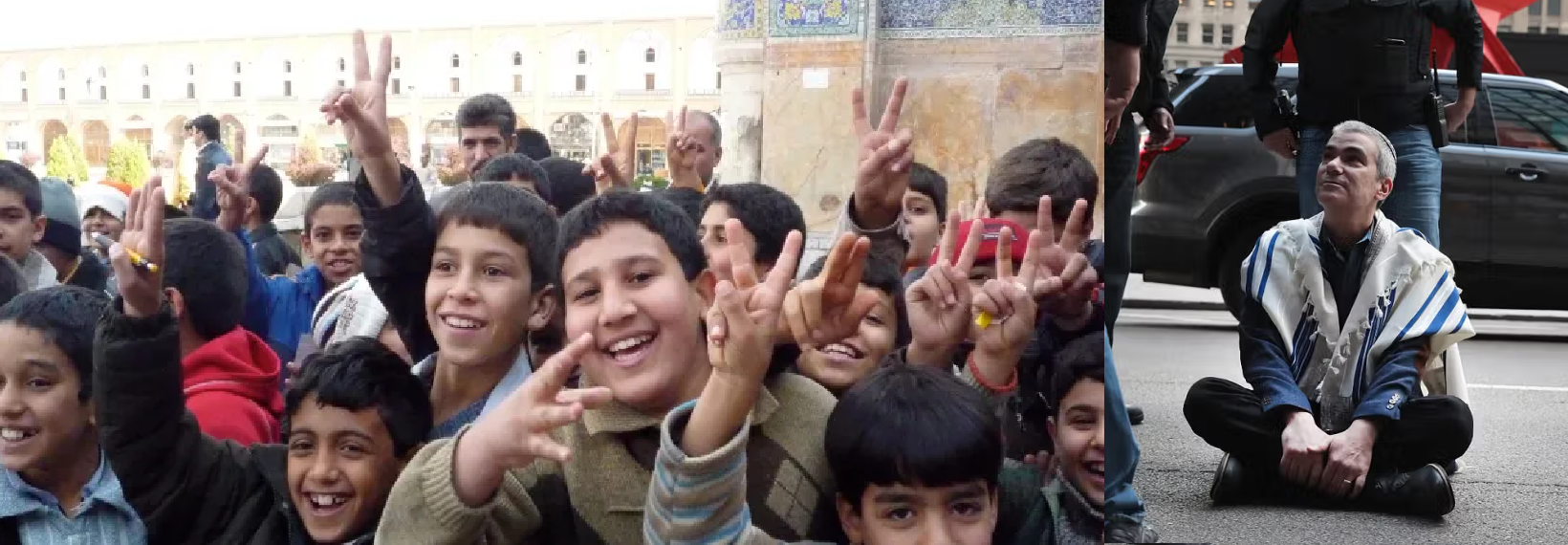
I will also never forget the sheer beauty of that country. In the city of Esfahan, we spent an entire day visiting exquisite 17th century mosques made almost entirely out of deep blue mosaic tiles. We hiked around massive, majestic Imam Square, one of the largest city squares in the world. We went to Persepolis and hung out all day with a group of teenagers. We met a class of architectural students while touring mosques in Esfahan; we encountered a large group of young schoolkids in Tehran, who peppered us nonstop with hilarious questions. Over and over, we heard a variation on a common theme: Iranians had no problems with Americans – in fact there was much about us that they admired: our culture of speaking up and speaking out, and the individual freedoms that we tend to take for granted.
Today, as I read reports of the US and Israel sending bombs and missiles into the people and places we visited, these sacred memories are curdling into fear and anger. When I heard that the US military had bombed an elementary school in Minab, killing 168 school children, I thought back to that amazing crowd of schoolkids we met that day in Tehran. When I learned they are destroying historic sites in Esfahan, I just know it includes the gorgeous mosques we visited that day in Imam Square. When I think of all the people we met, ordinary people sharing their stories and their dreams of living normal lives – I just know in my heart that it’s them – not the government of Iran – who are the true victims of this murderous onslaught.
Right now I’m holding on for dear life to those 10 days in 2008, that brief moment of deep connection and common humanity, hoping against hope that there’s something better beyond all this heinous state violence and militarism. As the great Hafez wrote in a poem that may well have been read by a young woman that night in a chilly Shiraz graveyard:
I once asked a bird, how is it that you fly in this gravity of darkness? She responded, ‘love lifts me.’