
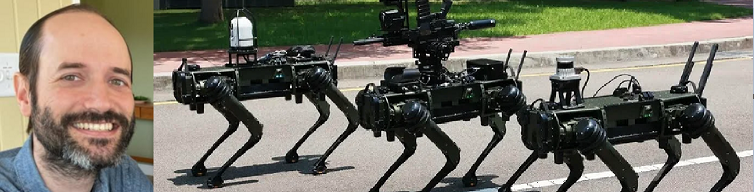
Charles Johnson is CAPA’s Organizing Director. We’re pleased to be able to share this essay.
1. Uncrewed and autonomous weapons
“Uncrewed” weapons are now a major feature of warfare, deployed without humans present at the site of use. Some uncrewed weapons are controlled by humans, some are controlled by humans with AI assistance, and some aim to be fully AI-controlled or “autonomous.”
Uncrewed weapons that are human-controlled or AI-assisted are already widespread. They include drones, seacraft, and wheeled robots, with armed “robot dogs” and humanoid robots on the way.
Uncrewed weapons that are fully autonomous aren’t widely deployed yet, but are being developed. Designers work to make them capable of finding, tracking, and attacking targets with little or no human input.
Playing a large role in these emerging and evolving systems is U.S.-based corporation Palantir. One of Palantir’s major clients is Ukraine’s military.
2. Gaps in Ukraine’s uncrewed approach
Since Russia’s invasion in February 2022, Ukrainians have developed uncrewed systems ranging from homemade models to expensive multipurpose systems. With a far smaller population than Russia’s, this has partly closed the gap between the sides’ military capacities.
But most uncrewed weapons still need human operators, leaving Ukraine at a deficit. Attempts to increase Ukraine’s human participation through steps like restricted movement, forced conscription, arrests, fines, suppression of speech, and foreign recruitment still leave huge gaps.
Enter Palantir, whose partnership with Ukraine’s military emerged in May 2022 and became official the following year. While the partnership has increased Ukraine’s uncrewed weapons capacity, an autonomous uncrewed weapons breakthrough hasn’t appeared yet.
3. Mikhail Fedorov and the Army of Robots
Mikhail Fedorov rose to prominence in 2022 as Ukraine’s Minister for Digital Transformation. He helped advance a tech-central war approach through several initiatives: the Army of Drones project; a “game-ified” app letting soldiers earn points for battlefield strikes and kills; and the Brave1 marketplace or “Amazon.com for weapons.”
In 2023, Fedorov helped secure Ukraine’s official partnership with Palantir. His data-driven, tech-forward approach aligned with Palantir’s vision of digital and military dominance.
By January 2026, Fedorov had been appointed Minister of Defense. But in July 2026, President Zelensky abruptly dismissed him. The dismissal outraged many in the West and those in Ukraine who supported Fedorov’s approach.
Despite public protests and various compromises offered by Zelensky, Fedorov didn’t return to government. But the tech pioneer personally continued the search for an autonomous breakthrough, revealing an ambitious proposal called Army of Robots in September 2026. Palantir quickly became its first investor.
Meanwhile, Ukraine’s military also continues its deep integration with Palantir, pursuing “global defense innovations.” Both Ukraine’s military leaders and Fedorov count Palantir as a key partner in the ongoing search for autonomous weapons.
4. Critiques of autonomous weapons
Critics note several reasons to challenge the trend toward autonomous weapons.
First, innovation begets imitation. Many of Ukraine’s prior military innovations have been replicated and outscaled by Russia’s military. The same will likely happen with autonomous systems. Expected results include more weapons and danger collecting on all sides.
Second, harming the most vulnerable. Autonomous weapons investment is currently booming, but those likely to face the worst effects are soldiers and civilians on both sides. The working classes are crushed by each wave of war innovations.
Third, further normalizing killing. Distancing ourselves from the act of killing makes it easier to carry out, which is one reason militaries use “game-ified” and uncrewed approaches. Autonomous uncrewed weapons are the ultimate distancer, requiring little or no human input.
Fourth, unknown consequences. The future effects of autonomous weapons pose major risks to humanity. They may worsen power imbalances, operate in unwanted ways, and create dystopian scenarios that are hard to reverse.
5. Conclusion
Peace supporters can work to stigmatize autonomous weapons, including projects like Army of Robots. We can organize to boycott, protest, and resist the parties involved in their development.
We can reject war methods of all kinds, and raise awareness of life-affirming security approaches like Unarmed Civilian Protection.
And instead of weapons, we can support advances in technology that improve human connection across conflicts, cross-cultural exchange, and working class solidarity.